
Contents
In brief
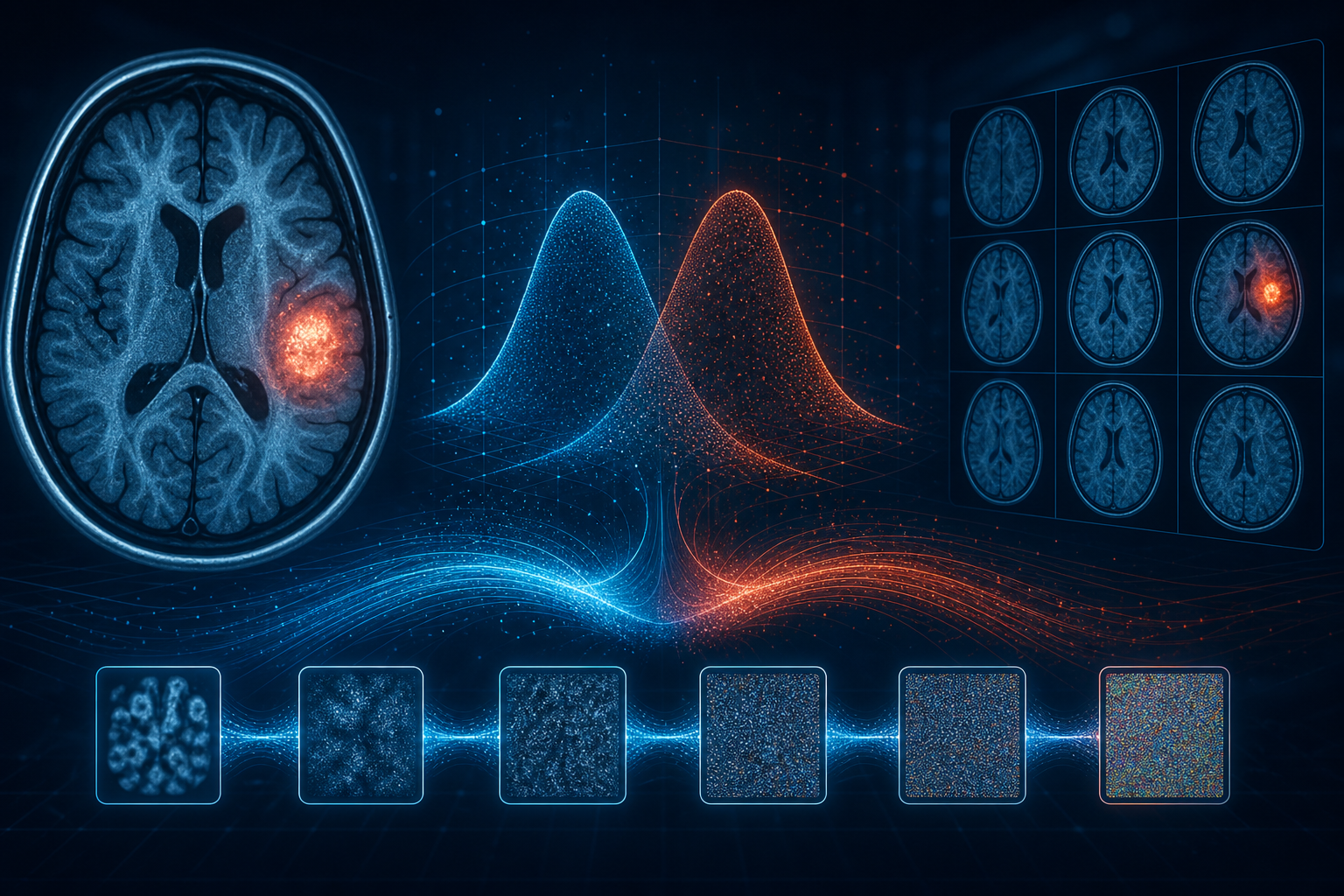
Diffusion models serve as priors in computational imaging, but struggle with subtle or localized distribution shift — foreign patches hidden inside a frame. KLIP uses KL divergence between prior and posterior without calibration data from anomalous domains.
What they studied
Classic OOD detectors often need knowledge of the shifted distribution or score whole images only. KLIP works on indirect measurements typical of inverse problems.
Experiments detect semantically meaningful shifts (e.g., healthy liver CT → tumor cases) and localize suspicious patches.
Key findings
- No separate calibration set from the shifted domain required.
- Generalizes across diffusion model types, datasets, and inverse problem setups.
- Open-source code: voilalab/KLIP on GitHub.
What this means for developers
- Add domain checks before inference in imaging restoration pipelines.
- Localized anomaly scores beat binary whole-image OOD flags.
- For MLOps, track KL-like train vs production batch metrics as early drift signals.
Limitations
Focused on inverse problems and diffusion priors; not demonstrated for tabular ML. Medical examples need clinical validation — engineering signal, not diagnosis.