Contents
In brief
Agent stacks increasingly execute generated code as part of the live runtime—not throwaway completions. This preprint frames governed evolution: validated, traceable, measurable changes with rollback, via HarnessMutation, rather than “the agent rewrote production.”
What they studied
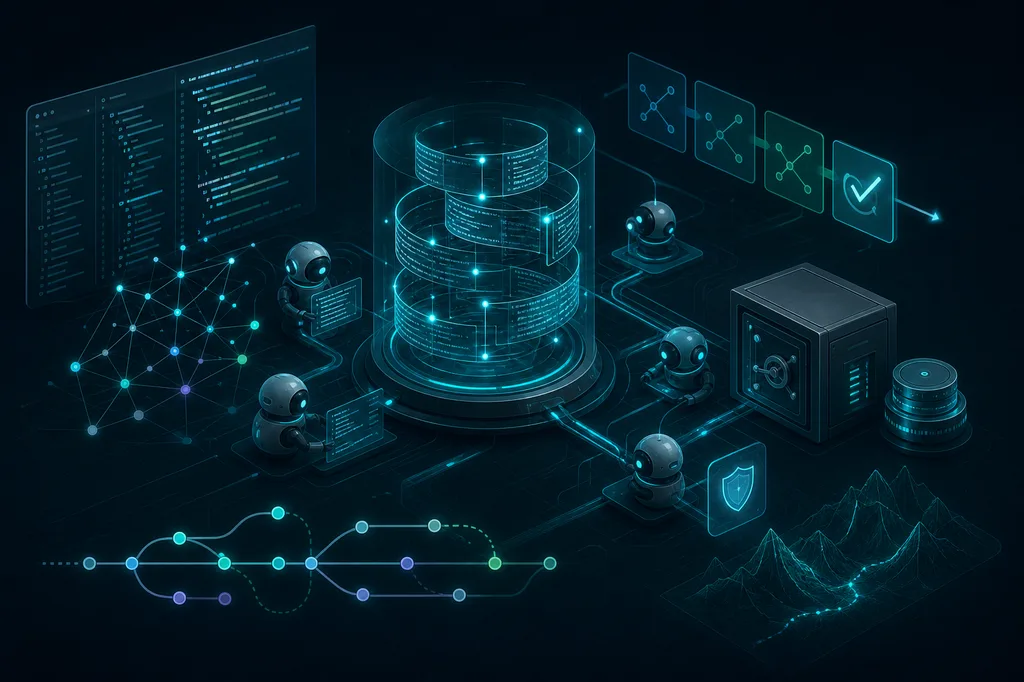
Building on Code as Agent Harness, validated artifacts become persistent runtime capabilities (create, run, revise, reuse across long loops). The author formalizes executable operational cognition and HarnessMutation as bounded adaptation over operational memory—not unconstrained self-modification.
Key findings
- The gap is less “can agents write code?” than lifecycle and governance of durable artifacts.
- Runtime evolution should be bounded, traceable, and reversible.
- The model targets modern agent orchestration as an auditable adaptive infrastructure pattern.
What this means for developers
- Sandbox agent writes—never mutate prod harness directly.
- Version agent-generated modules like DB migrations: diff, review, canary.
- Route “self-improvement” through test → metric → approve → deploy pipelines.
- Log operational memory (scripts surviving across sessions) or debugging fails.
Limitations
Conceptual preprint—no boxed product or benchmark shootout vs LangGraph/AutoGen. Teams must map principles to their own stack.