
Contents
Agentic engineering is a way of building software in which an AI agent does more than complete the next line. It receives a bounded task, investigates the repository, changes files, runs checks, and returns a result that can be verified. Autonomy alone does not create value. The value comes from the system around it: high-quality context, executable completion criteria, least-privilege access, independent review, and fast feedback.
In 2026, the question is no longer whether AI can write code. It can. The practical question is: can a team verify a growing volume of changes faster than defects, architectural drift, and verification debt accumulate? This guide presents an operating model for senior developers, tech leads, and engineering leaders—without promising that a “swarm of agents” can replace a team.
Key takeaways
Agentic engineering is not a new name for vibe coding. Vibe coding optimizes for how quickly you can produce a working prototype. Agentic engineering optimizes for repeatability: task, boundaries, evidence, review, and rollback. The first approach is appropriate for a disposable experiment; the second is necessary for code expected to survive in production.
Context matters more than a long prompt. An agent needs architectural boundaries, verification commands, security rules, and a way to retrieve details on demand. Loading an entire repository into context increases cost and often reduces accuracy.
Verification is the scarce resource. Changes can be generated in parallel, but responsibility for their correctness remains with the team. When pull request throughput grows faster than testing, review, and observability capacity, the result is verification debt.
Multiple agents help only when their boundaries are genuinely independent. “Planner, implementer, and critic” sounds persuasive, but three models reading the same ambiguous request do not provide three independent sources of evidence. Orchestration is justified when roles have different inputs, tools, and completion criteria.
AI amplifies the engineering system already in place. DORA describes AI as an amplifier: a mature platform and fast feedback loops turn it into acceleration; tightly coupled architecture and weak checks turn it into additional instability.
From autocomplete to agentic development
Autocomplete proposes the next fragment in the open file. A chat assistant explains code and prepares a patch from an instruction. An agent operates in a loop: it gathers context, builds a plan, invokes tools, observes the result, and adjusts its next action.
The difference is not merely the length of the task. An agent has an execution surface: the file system, shell, browser, Git, CI, issue tracker, and sometimes infrastructure. The broader that surface becomes, the more the agent resembles a new team member—and the less appropriate it is to treat adoption as “install an extension and start using it.”
A useful autonomy scale looks like this:
| Mode | What the AI does | What the human does | Risk |
|---|---|---|---|
| Autocomplete | Suggests a local fragment | Writes and accepts each line | Low |
| Conversational assistant | Explains, designs, and creates patches | Directs every step | Moderate |
| IDE agent | Finds files, changes code, and runs tests independently | Defines the task and reviews the diff | Medium |
| Background agent | Works in a separate branch or environment for minutes or hours | Reviews the outcome and evidence | High |
| Orchestration | Several specialized agents handle parts of the work | Defines the system, escalation paths, and gates | Very high |
As autonomy increases, model “intelligence” matters less than the quality of the scaffold. A concise analysis of the new SDLC expresses this as Agent = Model + Scaffold. Models become interchangeable faster than access architecture, rules, and verification systems do.
Vibe coding and agentic engineering solve different problems
Vibe coding is useful when the cost of failure is low: testing a UI idea, writing a disposable script, or assembling a demo. The developer judges the result by eye and continues until it “seems to work.”
The problem begins when that mode quietly moves into a long-lived product. Code may pass a manually tested happy path while violating an API contract, database migration invariant, accessibility requirement, threat model, or retry semantics. A confident model response can conceal the absence of evidence.
Agentic engineering changes the unit of work. The deliverable is not a diff but a change package:
- a stated intent and explicit boundaries;
- a plan with its assumptions;
- a minimal diff;
- completed verification;
- known risks and unverified areas;
- a rollback or safe-disable mechanism.
Code remains important, but it is no longer the only artifact. A good agentic loop resembles the work of a strong engineer: understand the system first, change it second, and then prove that the change satisfies the task.
What the research says—and what it does not prove
Discussion of AI-assisted development tends toward two extremes: vendor case studies reporting enormous time savings, and the claim that “AI always slows senior engineers down.” The evidence is more complicated.
In a randomized METR study, 16 experienced participants completed 246 tasks in mature open-source repositories they already knew. Using early-2025 tools, they took 19% longer on average, even though after the experiment they believed AI had made them 20% faster. This is strong evidence that perceived and measured productivity can diverge. It is not a universal coefficient, however: the sample was small, the participants were experts in those specific codebases, and models and tools are changing quickly.
The DORA 2025 report, based on nearly 5,000 professionals, presents a different scale of evidence. AI adoption correlates with improved throughput and product performance, but it is still associated with worse delivery stability. The conclusion is neither “AI is good” nor “AI is bad.” It is that acceleration exposes weaknesses in downstream systems.
Anthropic reports that developers use AI in roughly 60% of their work while fully delegating only 0–20% of tasks. These are vendor-supplied figures and should not be mistaken for a neutral audit. They do, however, illustrate the practical distinction between using a tool and transferring responsibility.
No external benchmark matters more than a team’s own. Do not measure generated lines of code. Measure the time from task definition to verified outcome, rework rate, incidents, and review load.
Context engineering: what an agent needs to know
Prompt engineering asks, “How should we phrase the request?” Context engineering asks, “Which facts, rules, and tools must be available to the agent at each step?”
Context has four layers.
Persistent rules
A concise AGENTS.md, project rule, or skill should define the stack, prohibited actions, test commands, architectural principles, and expected output. It should not become an encyclopedia of the repository. Dozens of pages of permanent instructions consume the context window and blur priorities.
Task context
This includes the issue, acceptance criteria, example inputs and outputs, migration constraints, and an explicit statement of what is out of scope. A well-defined task should allow two engineers to produce reasonably comparable outcomes.
On-demand context
Agents can retrieve code, documentation, database schemas, ADRs, logs, and APIs through MCP as needed. A recent guide to MCP in production explains how to give agents useful tools without hidden sessions or shadow integrations.
Environment feedback
The compiler, tests, linter, security scanner, preview environment, and metrics provide the most valuable context of all: observable consequences rather than opinions.
The rule is simple: provide stable constraints statically, retrieve details dynamically, and verify behavior through execution.
Decomposing tasks for an agent
A poor task says, “Rewrite authentication, improve the architecture, and add tests.” It combines investigation, design, migration, and implementation, with no completion criterion.
A good task fits into one verifiable increment:
- A goal expressed as user or system behavior.
- Permitted directories and interfaces.
- Contracts that must remain unchanged.
- Verification commands.
- Escalation conditions.
For longer efforts, use the sequence investigation → plan → implementation → verification. This is not because a model must “think out loud.” It is because these phases give the human inexpensive stopping points. Rejecting a flawed plan is cheaper than undoing changes across twenty files.
Task size depends not on line count but on the coupling between decisions. Migrating a single flag may touch ten services and be a poor autonomous-agent task. An isolated hundred-line generator with a precise contract may be an excellent one.
When the agent must stop
Define stop conditions in advance: conflicting requirements, a required destructive command, unknown data ownership, a public API change, or access to production, secrets, or personal data. Escalation is not a failure of autonomy. It is evidence that risk controls are working.
Verification loops: tests matter more than eloquence
An agent without feedback optimizes for plausibility. An agent with a compiler, tests, and an observable environment can optimize for outcomes.
A good verification loop:
- Runs automatically.
- Produces a localized, actionable failure.
- Tests the requirement, not syntax alone.
- Has limits on execution time and retry count.
- Does not allow the agent to “fix the test” when the test is the contract.
The evidence hierarchy depends on the task:
- type checking and linting catch structural defects;
- a unit test confirms local logic;
- an integration test verifies boundaries;
- an end-to-end or browser check exercises the user journey;
- a security scan detects known threat classes;
- post-canary metrics reveal behavior in the real system.
Requiring “every check” for every change is counterproductive: the loop becomes expensive, and the agent spends longer waiting for CI than doing the work. Use a risk-based matrix. A copy change might require a build and visual smoke test; a data migration needs backups, a dry run, integration testing, and a rollback rehearsal.
Verification debt: a new form of technical debt
Verification debt appears when the volume of generated changes exceeds a team’s ability to prove them correct. It is not limited to unreviewed pull requests.
Warning signs include:
- pull requests grow because generating “just a little more” is cheap;
- tests written by the same model repeat the model’s original assumption;
- reviewers read summaries instead of diffs;
- green CI covers only the happy path;
- documentation and architectural decisions diverge from the code;
- merge frequency increases, but so do rollbacks and hotfixes.
Verification debt cannot be paid down by adding more unverified AI review. It requires independence: a different source of evidence, a deterministic tool, a domain owner, or a separate model operating with a distinct role and context.
A practical control is a work-in-progress limit for agent tasks. If only two people can competently review a subsystem, running ten agents in parallel creates a queue, not acceleration.
One agent or several
Multi-agent orchestration should be justified by the structure of the work, not by fashion.
One agent is better when the task is cohesive, the context is shared, and the final diff is small. It spends less time transferring context and reconciling outputs.
Multiple agents help when:
- task components are genuinely independent;
- investigation can be parallelized across subsystems;
- the verifier receives a different toolset;
- outputs meet a formal interface contract;
- an integrator owns the overall result.
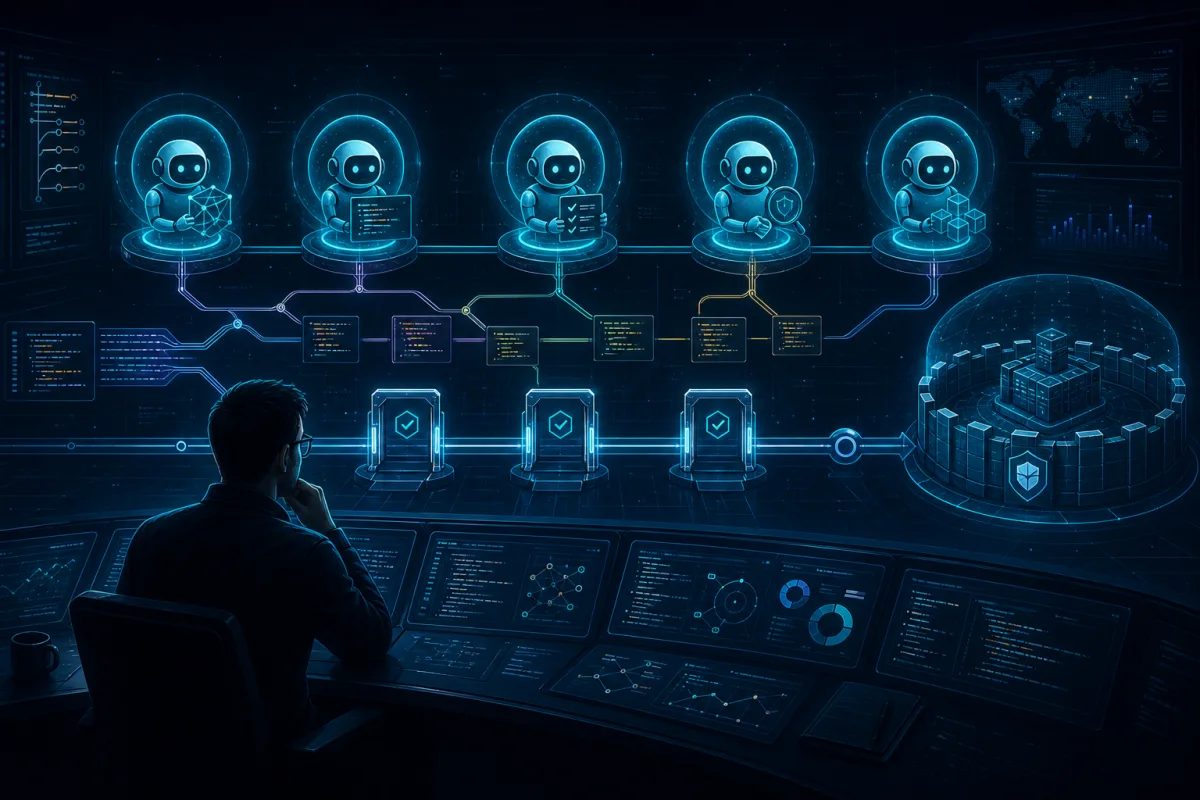
One workable division of responsibility is:
| Role | Output | Must not do |
|---|---|---|
| Researcher | Facts, files, and constraints | Change code |
| Planner | Change sequence and acceptance criteria | Invent missing facts |
| Implementer | A bounded diff | Expand scope |
| Verifier | Counterexamples and check results | Rewrite the solution without cause |
| Integrator | A coherent change package | Blindly merge branches |
Five roles do not imply five models on every ticket. They are a logical separation of responsibilities; for a simple task, one agent can move through the stages sequentially.
Security: an agent’s permissions define its potential damage
A coding agent reads untrusted text from issues, README files, tool output, and web pages. Any of these sources may contain a prompt injection. If the same process also has shell access, network access, and secrets, a text-based attack can become an action.
A minimum security model includes:
- a separate working copy or ephemeral environment;
- deny-by-default access to the network and files outside the project;
- short-lived credentials;
- no secrets in prompts or logs;
- confirmation for destructive actions;
- audit logs for commands and tool calls;
- output written to a separate branch, never directly to
main.
A container is not an absolute security boundary. For untrusted code, a microVM or purpose-built sandbox provides stronger isolation. The details are covered in this article on sandbox security for agentic AI.
Security must be continuous. Permission to read a repository does not imply permission to publish a package; staging access does not imply production access. Re-evaluate authorization at every sensitive action.
Integrating agents into the SDLC
Do not place an “AI step” on top of the old process. Examine the entire delivery flow.
Discovery and planning
The agent gathers related issues, locates code and ADRs, and formulates unanswered questions. A human approves the scope and trade-offs.
Implementation
The agent works in an isolated branch, producing small commits or one reviewable diff. Verification commands are known before implementation begins.
Review
Automated checks produce evidence; AI review searches for classes of defects; the subsystem owner makes the architectural decision. A summary does not replace the diff.
Delivery
Use canaries, feature flags, rollback mechanisms, and observability. An agent may prepare a release, but any expansion of the blast radius requires separate approval.
Learning
Failures become tests, rules, skills, or platform improvements. Rule files should be updated after real failures, not allowed to grow from hypothetical fears.
More practices used by effective teams appear in this analysis of AI adoption across the SDLC.
Metrics: determining whether agentic development works
Prompt count, token consumption, and lines of code are operational data, not measures of value. Track three layers instead.
Flow
- Lead time from accepted task to production.
- Cycle time from implementation start to a verified pull request.
- Batch size and number of concurrent tasks.
- Time spent waiting for review and CI.
Quality
- Change failure rate.
- Rollback and hotfix rate.
- Post-release defects.
- Rework: the share of AI-generated changes substantially rewritten by a human.
- Coverage of requirements by executable checks.
Economics and experience
- Cost of the agent run, CI, and review.
- Senior-engineer time spent specifying and verifying work.
- Share of tasks in which the agent stopped correctly.
- Developer satisfaction, without using it as a substitute for objective metrics.
Compare similar task classes, not “the month before Cursor” with “the month after Cursor.” Establish a control sample and inspect medians and tail outcomes: the average conceals rare but extremely expensive failures.
How the developer’s role changes
The role does not collapse into “prompt engineer.” As syntax becomes cheaper, the following capabilities become more valuable:
- choosing the right problem;
- identifying hidden contracts;
- decomposing work along real boundaries;
- building a verification system;
- assessing risk and blast radius;
- making decisions when evidence conflicts.
Junior developers can see examples and receive explanations faster, but they may fail to develop a mental model of the system. Training should therefore require them to predict outcomes, debug failures, and explain diffs—not merely accept generated code.
Senior engineers stop being simply the fastest code authors and become owners of the system that produces changes. This aligns with the career model in the Junior-to-Senior Go Developer roadmap: level is defined by scope of responsibility, not by the number of familiar tools.
A 90-day adoption plan
Days 1–30: a measurable pilot
Choose one repository and two task classes—for example, unit tests and small bug fixes. Record baseline cycle time, rework, and defects. Give the agent minimal permissions, a concise rule file, and explicit verification commands. Limit work in progress.
Days 31–60: the quality system
Add risk-based verification, a sandbox, audit logging, and an evidence template for pull requests. Analyze cancelled runs as well as successful ones. Every recurring failure should become a test, a rule, or a tool constraint.
Days 61–90: scaling
Add a second repository or a background execution mode. Try multi-agent workflows only after single-agent results are stable. Create a catalog of approved tools and MCP servers, with owners and update policies. Compare results with the baseline.
Expansion decisions should be based on data, not a demo: is the verified outcome faster, has instability remained controlled, and does the review effort produce a positive return?
Common mistakes
Buying licenses and calling it transformation. A tool without a process amplifies existing bottlenecks.
Maximizing autonomy on day one. Start with a narrow read/write boundary and explicit evidence, then expand.
Loading the entire repository into context. On-demand retrieval is cheaper and more precise.
Using one model to generate the change, tests, and review. The same faulty assumption can pass through all three layers.
Measuring adoption instead of outcomes. A 90% active-user rate says nothing about stability.
Running more agents in parallel than the team can review. A pull request queue turns faster generation into slower delivery.
Banning AI entirely because it creates risk. Shadow usage will persist, but without a sandbox, policy, or audit trail.
Frequently asked questions
What is agentic engineering in simple terms?
It is software development in which AI performs a bounded cycle of work on code while the team controls the context, permissions, checks, and responsibility for the outcome.
How is agentic engineering different from vibe coding?
Vibe coding accepts an outcome that plausibly appears to work. Agentic engineering requires reproducible criteria, tests, review, risk controls, and rollback.
Does AI really slow experienced developers down?
In the METR study, early-2025 tools slowed a specific sample of experienced open-source developers by 19%. That is an important warning, but not a universal estimate for every tool and task in 2026.
Do we need to use multiple agents?
No. Start with one. Multiple agents are useful only when work can be separated into independent parts, verification roles differ, and integration follows an explicit contract.
Can AI review replace a human reviewer?
It can partially replace checks for routine classes of defects. Architectural trade-offs, product intent, and risk acceptance remain the responsibility of an authorized human.
What belongs in AGENTS.md?
Include the stack, architectural boundaries, prohibited actions, verification commands, security requirements, and required output format. Do not copy details that the agent can reliably retrieve from the code.
How do we prevent an agent from stealing secrets?
Do not put secrets in context. Use short-lived credentials, restrict network and file-system access, isolate execution, and log sensitive actions.
Which tasks are best for getting started?
Start with local bug fixes, tests for existing behavior, small template-driven migrations, documentation, and mechanical changes backed by a strong compiler or test suite.
Which tasks should remain with humans for now?
Keep ambiguous product decisions, broad architectural migrations without a test harness, high-blast-radius actions, and work whose correctness cannot be verified under direct human ownership.
Will coding agents replace developers?
They will replace some operations and reshape the role. Responsibility for the system, priorities, verification, and risk does not disappear; in mature products, it becomes more important.
Further reading
- The new SDLC: vibe coding vs. agentic engineering
- How effective teams adopt AI in software development
- MCP in production in 2026
- Sandbox security for agentic AI
- Secure enterprise AI development
- Enterprise AI observability
- The path from Junior to Senior Go Developer
External sources: DORA 2025 State of AI-assisted Software Development, METR—Measuring the Impact of Early-2025 AI on Experienced Open-Source Developer Productivity, and Anthropic—Eight trends defining how software gets built in 2026.
Conclusion
Agentic engineering does not make engineering discipline unnecessary—it makes that discipline the limiting factor. As code generation accelerates, quality is determined by how quickly a team can define tasks, obtain evidence, and make decisions.
The practical strategy for 2026 is straightforward: narrow scope, on-demand context, least-privilege access, executable checks, independent review, and metrics that follow work from task definition to stable production. Increase autonomy only after the team can observe and constrain its consequences. An AI agent can write a change; the engineering system must prove that the change is worth shipping.
Short Lab intro: Chemistry of Code.
Need this on your systems?
If you want a production vertical slice—RAG, agents, MCP tools, or an LLM gateway with budgets—see the AI implementation service.
Related: AI guardrails, prompt injection defenses, evaluation harness.