


Contents
A gym with the same dumbbells every day does not prepare you for the street: muscles get used to one load and fail as soon as the weight shifts slightly. A dataset behaves the same way — the model is not learning to "read forms in general," but to recognize exactly the kind of crops you showed it.
If every cell crop looks alike and an "empty" cell always looks like clean paper with no stains or lines, the next three steps of the course lose their point. Split by sheets (lesson 5) compares train and validation that look identical: sheet-style leakage stays invisible. The empty-cell detector (lessons 7–9) tells a white square from digits — the task is too easy, a rule like "is there ink?" is enough and the network barely learns. The cascade (lesson 18) has nothing to stress-test: no dirty empty cells where the guard and the reader should disagree.
So this lesson has two goals. First — get a dataset without manual labeling. Second, more important — bake into the synthetic data the properties of real forms where errors show up later. In lesson 3 we locked the alphabet and format. Today the series Train CNN and CRNN from scratch builds the data and a thin adapter layer so the rest of the course does not care where the crops came from.
Files for this lesson
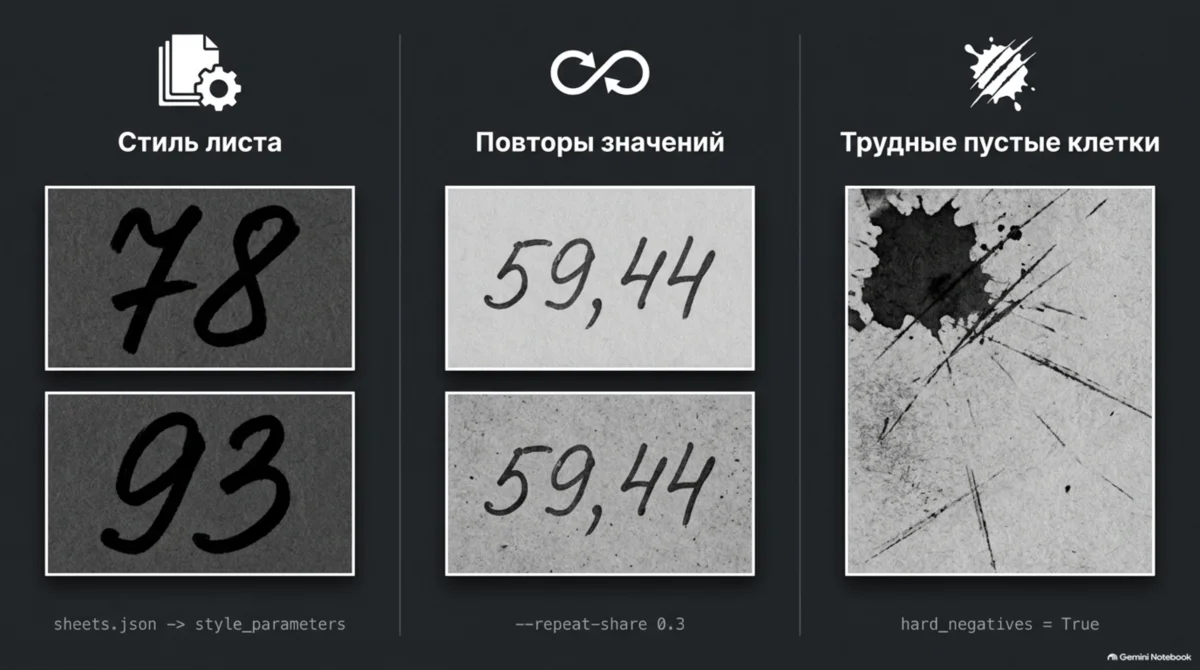
src/make_synthetic_crops.py— generator: sheets with their own style, repeated values, hard empty cells.src/patterns.py— label "pattern" class (int,dec1,dec2,lead0, …): for stats now and stratification in lesson 5.src/data_sources/base.py— adapter contract and record checks.src/data_sources/synthetic.py— first adapter implementation (reads the generator folder).src/data_sources/__init__.py— makes the folder a package.src/prepare_dataset.py— source →all.jsonl+manifest.json.experiments/show_samples_grid.py— sample grid from different sheets.tests/test_data_source_contract.pyandtests/test_synthetic_generator.py— tests.
Reference for comparison if generation does not match: lesson-04. You do not need to clone it: you add the lesson files in your own repository and commit.
Predict
"Predict" is not a grade. You fix an expectation before you run, then compare with the manifest and the contract report.
Before you run, write the answers:
- How many crops do you get with
--sheets 250 --per-sheet 20, and what fraction are empty? - With
--repeat-share 0.3, what fraction of value crops will repeat a value already seen on the same sheet: less than 30 %, about 30 %, or more? - What should happen if the source returns a crop labeled
7.3(with a dot)?
How the generator works
The generator is the longest file in the course (about 280 lines). Six ideas below define the design; full code is in the collapsed block under "Write it yourself." If the commands do not produce the output in "Expected," compare your files with the reference lesson-04 in the browser.
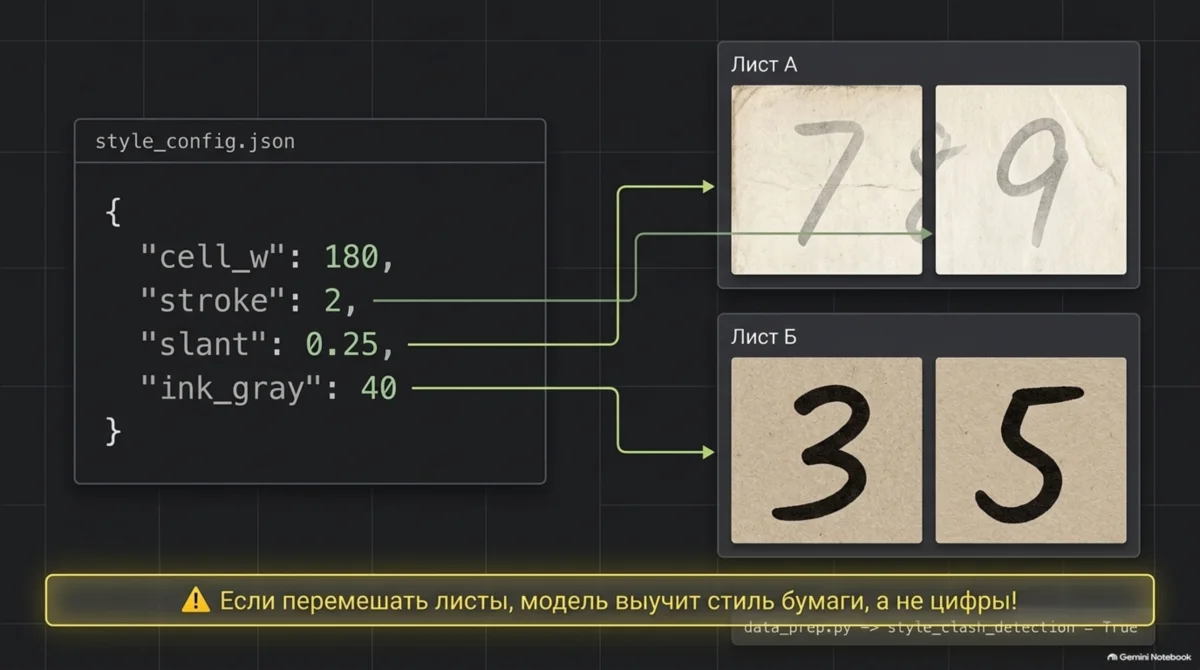
1. Sheet = style. Each sheet gets its own parameter set (written to sheets.json), and every crop on that sheet is drawn in that style.
| Parameter | What it changes |
|---|---|
cell_w, cell_h |
cell size (≈ 110–200 × 40–64 px) |
font_ratio |
digit size relative to cell height |
stroke |
pen thickness (0, 1, or 2 px outline) |
slant |
tilt of the whole line |
jitter_dy, jitter_rot |
how much individual symbols shift vertically and rotate |
ink_gray, paper_gray |
ink and paper color |
paper_noise, shade, blur |
paper noise, lighting gradient, blur |
border, border_gray |
whether the cell has a border line |
Why it matters: in real scans, crops from one sheet look alike (one pen, one paper, one scanner). If the split shuffles sheets, the model learns sheet style, not digits. In lesson 5 we will see that with our own eyes.
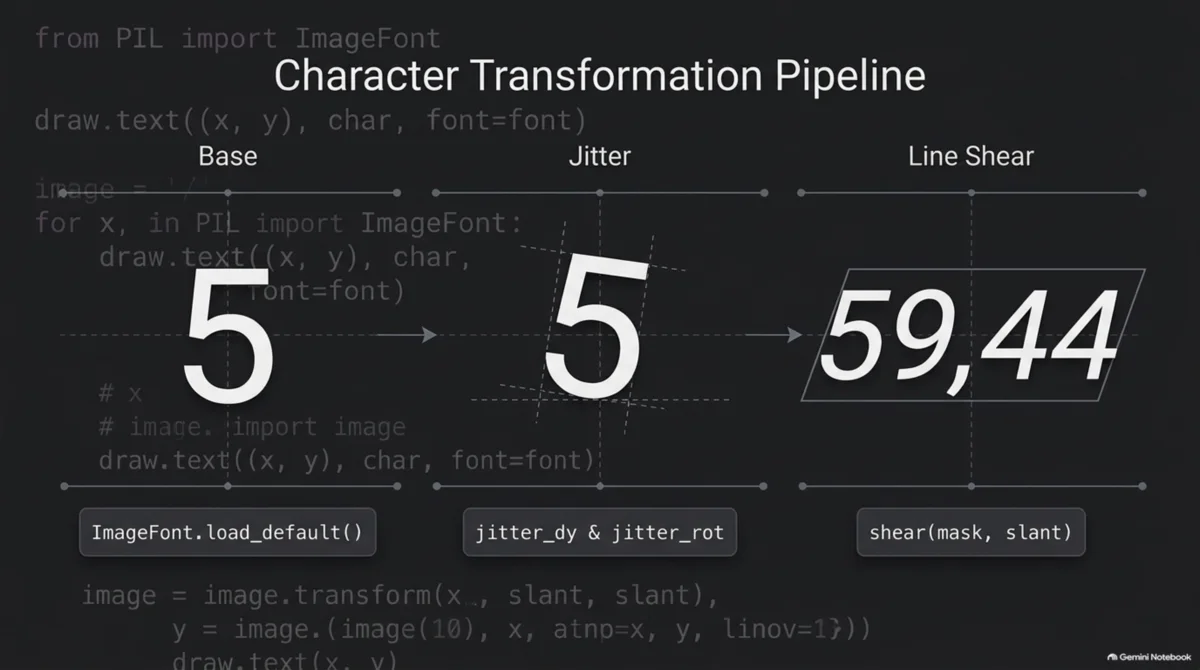
2. Characters are drawn one by one. Each character gets a small shift and rotation, then the whole line is slanted. Digits look handwritten, not like a typeset font. Inside we use Pillow's only built-in font; variety comes from geometry and the pen.
3. Values repeat within a sheet. With probability --repeat-share (default 0.3) a crop repeats a value already seen on that sheet. Real forms do that. That is what makes leakage in lesson 5 obvious: if neighboring cells from one sheet land in both train and val, the model can just memorize the answer.
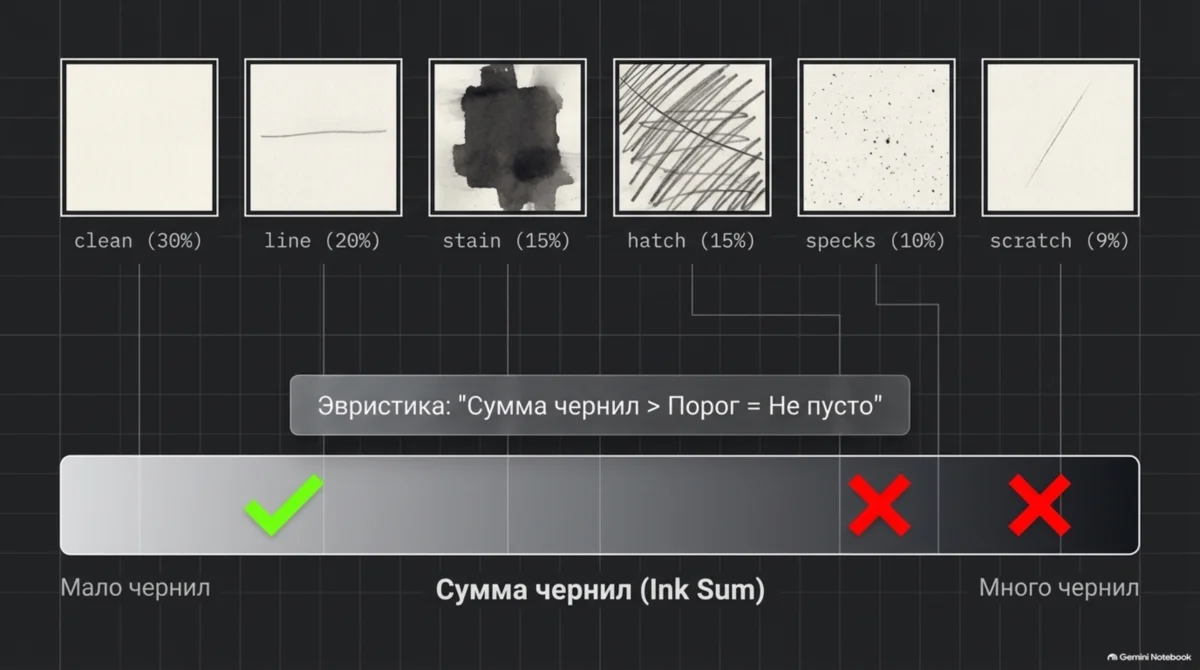
4. Empty cells can be hard. Clean paper is the easy case. Real empty cells are crossed out, underlined, stained, or scratched. The generator makes six kinds:
| Kind | What is drawn | Share among empties |
|---|---|---|
clean |
paper and noise only | ≈ 30 % |
line |
underline or vertical stroke | ≈ 20 % |
stain |
blurred blob | ≈ 15 % |
hatch |
cross-hatching (cell crossed out) | ≈ 15 % |
specks |
dots | ≈ 10 % |
scratch |
scratch mark | ≈ 9 % |
Picture a naive rule without a neural net: count how much "dark" (ink) is on the crop — little means empty, lots means digits. On clean paper that almost always works. But a crossed-out or stained empty cell also has plenty of ink — the rule says there is a value when there are no digits. Those examples are hard negatives: they look like filled cells by stroke count, but the label is empty. Without them, the detector in lessons 7–9 would learn to separate a white square from digits and fail on real grime.
5. Each sheet has its own random stream. Sheet number s is drawn with generator default_rng([seed, s]). So sheet #3 is identical whether you use --sheets 5 or --sheets 250. Test test_sheets_are_independent_of_total_count checks that.
6. Paper noise is weak on purpose. In lesson 2 we added a guard: if a crop's brightness range is below 30 levels, contrast is not stretched. That guard is coarse: it holds while noise stays weak. Hence paper_noise from 1 to 3. Test test_clean_empty_crops_are_left_alone_by_contrast_guard links lesson 4 to lesson 2 and turns red if you crank up noise.
The generator also has a --task flag: measurement (default), diameter, or thickness. We use the first today. The others matter in lesson 16.
Data source adapters
Contract. Any source returns records of one shape:
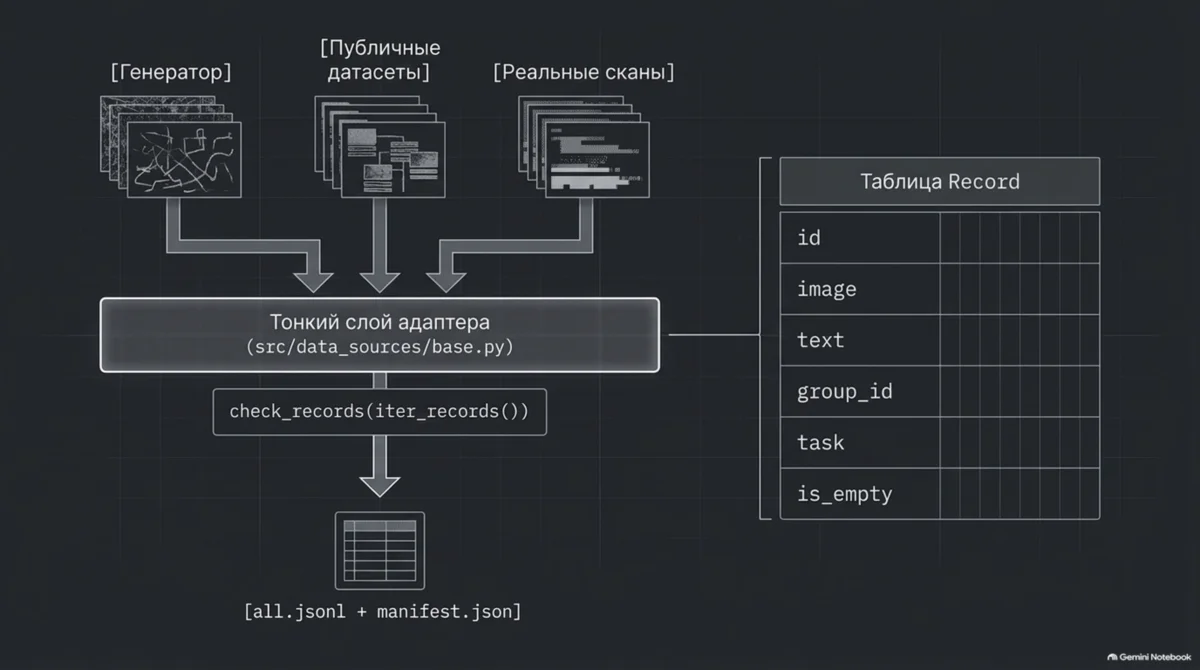
| Field | Meaning |
|---|---|
id |
unique crop identifier |
image |
path to the image relative to image_root |
text |
normalized label; '' for an empty cell |
group_id |
split unit (sheet, virtual sheet, official split from the source) |
task |
measurement, diameter, or thickness |
is_empty |
true for an empty cell |
Plus a meta() dict: source, task, alphabet, license, image_root. License goes into the manifest: when public data appears, that will matter.
The image path is stored relative to image_root (recorded in the manifest). You can move the dataset to another machine without rewriting all.jsonl.
src/data_sources/base.py
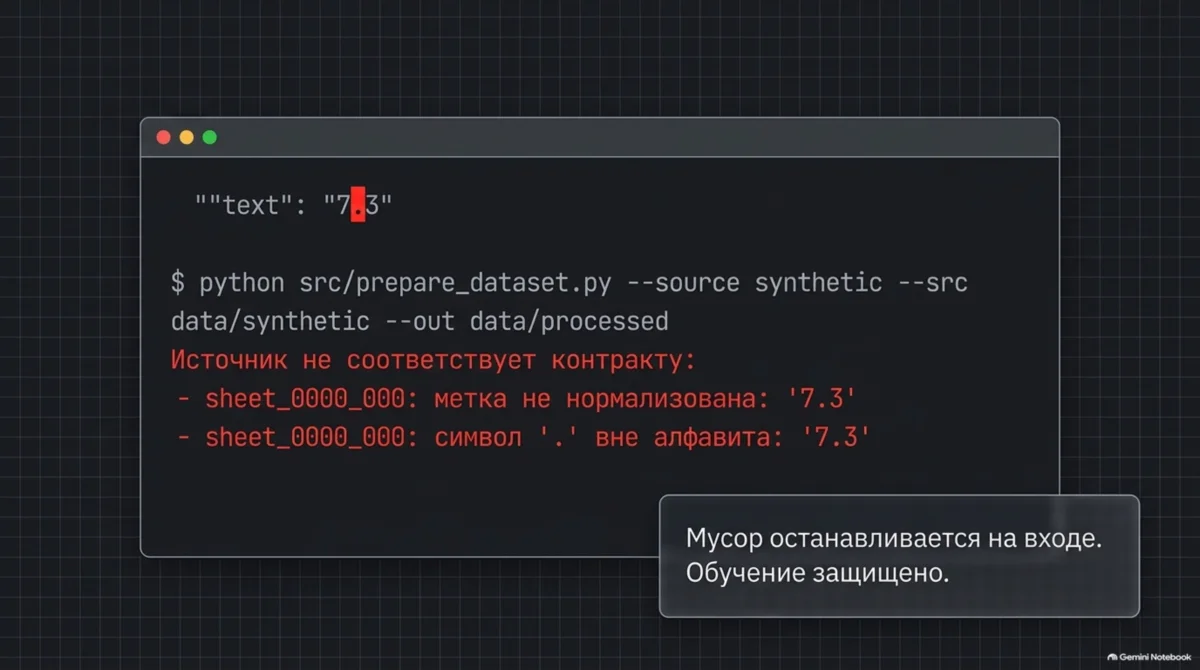
The most valuable piece here is check_records. It applies to every record everything from lesson 3: the label must be normalized, pass alphabet and format checks, and an empty label must match is_empty. Garbage stops at the input and never reaches training. Full file — under "Write it yourself."
src/data_sources/synthetic.py
The adapter almost does nothing: renames fields from the generator's native format (sheet → group_id, kind → is_empty) and builds meta(). That is what a good adapter should look like: thin.
src/prepare_dataset.py
The script picks an adapter by --source, checks the contract (on violation it prints a list and exits with code 1), sorts records, and writes all.jsonl and manifest.json. The manifest has no dates or timestamps: the same input always yields the same manifest. Sources public and real still say they will be wired later (appendices A2 and A4).
Write it yourself
First put the files in the repository from lesson 1. Blocks below are collapsed — expand and copy to the paths shown. The six generator ideas are in the section above; type the long code from the blocks, not from a terminal screenshot.
The generator calls validate_format from lesson 3. If src/alphabet.py still has NotImplementedError (TODO starter), finish the alphabet or copy the solution from lesson 3's collapsed block — otherwise make_synthetic_crops.py fails on the first label. Quick check: python -m pytest tests/test_alphabet.py -q → 12 passed.
Run lesson 4 commands after the files are in place and the alphabet is green.
src/make_synthetic_crops.py — generator (~280 lines) (expand)
"""Генератор синтетических кропов.
Что моделируем (это то, на чём потом ловятся ошибки):
* у каждого листа свой стиль: размер клетки, толщина пера, наклон, шум, фон;
* значения внутри листа повторяются (как в реальных бланках);
* пустые клетки бывают трудными: пятна, линии, штриховка, царапины.
Результат в папке --out:
images/<sheet_id>/<n>.png кропы
index.jsonl одна строка на кроп (родной формат генератора)
sheets.json стиль каждого листа
generator.json параметры запуска и версия генератора
"""
import argparse
import json
import math
from pathlib import Path
import numpy as np
from PIL import Image, ImageChops, ImageDraw, ImageFilter, ImageFont
from alphabet import normalize_label, validate_format
GENERATOR_VERSION = "1"
MEASUREMENT_KINDS = {"dec1": 0.50, "dec2": 0.25, "int": 0.20, "lead0": 0.05}
DIAMETER_KINDS = {"single": 0.60, "fraction": 0.40}
THICKNESS_KINDS = {"single": 0.45, "range": 0.55}
EMPTY_KINDS = {"clean": 0.30, "stain": 0.15, "line": 0.20, "hatch": 0.15, "scratch": 0.10, "specks": 0.10}
TASKS = ("measurement", "diameter", "thickness")
# ----------------------------------------------------------------------------- значения
def choice_weighted(rng: np.random.Generator, weights: dict):
keys = list(weights)
p = np.array([weights[k] for k in keys], dtype=float)
return keys[int(rng.choice(len(keys), p=p / p.sum()))]
def rand_int_part(rng: np.random.Generator) -> int:
n_digits = choice_weighted(rng, {1: 0.45, 2: 0.40, 3: 0.15})
lo = 1 if n_digits == 1 else 10 ** (n_digits - 1)
return int(rng.integers(lo, 10 ** n_digits))
def rand_number(rng: np.random.Generator) -> str:
"""Число для thickness: 1–2 цифры, иногда с десятичной запятой."""
base = int(rng.integers(1, 31))
return f"{base},{int(rng.integers(1, 10))}" if rng.random() < 0.5 else str(base)
def make_value(task: str, rng: np.random.Generator) -> str:
if task == "measurement":
kind = choice_weighted(rng, MEASUREMENT_KINDS)
if kind == "int":
return str(rand_int_part(rng))
if kind == "dec1":
return f"{rand_int_part(rng)},{int(rng.integers(0, 10))}"
if kind == "dec2":
return f"{rand_int_part(rng)},{int(rng.integers(0, 100)):02d}"
if rng.random() < 0.5:
return f"0,{int(rng.integers(1, 10))}"
return f"0,{int(rng.integers(1, 100)):02d}"
if task == "diameter":
if choice_weighted(rng, DIAMETER_KINDS) == "single":
return str(int(rng.integers(10, 1000)))
return f"{int(rng.integers(10, 100))}/{int(rng.integers(10, 100))}"
if task == "thickness":
if choice_weighted(rng, THICKNESS_KINDS) == "single":
return rand_number(rng)
return f"{rand_number(rng)}-{rand_number(rng)}"
raise ValueError(f"неизвестная задача {task!r}")
# ----------------------------------------------------------------------------- стиль листа
def sample_style(rng: np.random.Generator) -> dict:
return {
"cell_w": int(rng.integers(110, 201)),
"cell_h": int(rng.integers(40, 65)),
"font_ratio": round(float(rng.uniform(0.50, 0.70)), 3),
"stroke": int(rng.choice([0, 0, 1, 1, 2])),
"slant": round(float(rng.uniform(-0.25, 0.25)), 3),
"jitter_dy": round(float(rng.uniform(0.0, 1.8)), 2),
"jitter_rot": round(float(rng.uniform(0.0, 5.0)), 2),
"ink_gray": int(rng.integers(10, 91)),
"paper_gray": int(rng.integers(215, 253)),
"paper_noise": round(float(rng.uniform(1.0, 3.0)), 2),
"shade": round(float(rng.uniform(0.0, 5.0)), 2),
"blur": float(rng.choice([0.0, 0.5, 0.8])),
"left_pad": int(rng.integers(5, 15)),
"border": bool(rng.random() < 0.5),
"border_gray": int(rng.integers(120, 190)),
}
# ----------------------------------------------------------------------------- отрисовка
def get_font(size: int):
try:
return ImageFont.load_default(size=size)
except Exception: # старый Pillow или нет FreeType
return ImageFont.load_default()
def paste_lighter(dst: Image.Image, src: Image.Image, x: int, y: int) -> None:
"""Накладывает src на dst (берём более яркий пиксель), с обрезкой по границам."""
w, h = dst.size
sx0, sy0 = max(0, -x), max(0, -y)
dx0, dy0 = max(0, x), max(0, y)
cw = min(src.width - sx0, w - dx0)
ch = min(src.height - sy0, h - dy0)
if cw <= 0 or ch <= 0:
return
region = dst.crop((dx0, dy0, dx0 + cw, dy0 + ch))
patch = src.crop((sx0, sy0, sx0 + cw, sy0 + ch))
dst.paste(ImageChops.lighter(region, patch), (dx0, dy0))
def draw_text_mask(mask: Image.Image, text: str, style: dict, rng: np.random.Generator) -> None:
"""Рисует текст посимвольно (у каждого символа свой сдвиг и поворот) на маске чернил."""
w, h = mask.size
stroke = style["stroke"]
size = max(10, round(style["font_ratio"] * h))
pad = style["left_pad"] + int(rng.integers(-2, 3))
while True:
font = get_font(size)
advances = [font.getlength(ch) + 1 + stroke for ch in text]
if sum(advances) <= w - pad - 4 or size <= 10:
break
size -= 2
bbox = font.getbbox("0")
y0 = (h - (bbox[3] - bbox[1])) // 2 - bbox[1]
x = float(pad)
for ch, adv in zip(text, advances):
dy = float(rng.normal(0.0, style["jitter_dy"]))
rot = float(rng.normal(0.0, style["jitter_rot"]))
tile = Image.new("L", (int(adv) + size, size * 2), 0)
ImageDraw.Draw(tile).text((size // 2, size // 2), ch, font=font, fill=255,
stroke_width=stroke, stroke_fill=255)
if abs(rot) > 0.01:
tile = tile.rotate(rot, resample=Image.Resampling.BICUBIC)
paste_lighter(mask, tile, int(round(x)) - size // 2, int(round(y0 + dy)) - size // 2)
x += adv
def shear(mask: Image.Image, slant: float) -> Image.Image:
if abs(slant) < 1e-3:
return mask
w, h = mask.size
return mask.transform((w, h), Image.Transform.AFFINE, (1, slant, -slant * h / 2, 0, 1, 0),
resample=Image.Resampling.BICUBIC)
def draw_empty_marks(mask: Image.Image, kind: str, rng: np.random.Generator) -> None:
"""Трудные пустые клетки: пятна, линии, штриховка, царапины, точки (kind='clean' — ничего)."""
w, h = mask.size
draw = ImageDraw.Draw(mask)
if kind == "stain":
layer = Image.new("L", (w, h), 0)
ld = ImageDraw.Draw(layer)
for _ in range(int(rng.integers(1, 4))):
cx, cy = int(rng.integers(0, w)), int(rng.integers(0, h))
rx, ry = int(rng.integers(6, 22)), int(rng.integers(4, 14))
ld.ellipse([cx - rx, cy - ry, cx + rx, cy + ry], fill=int(rng.integers(50, 130)))
layer = layer.filter(ImageFilter.GaussianBlur(float(rng.uniform(2.5, 5.0))))
paste_lighter(mask, layer, 0, 0)
elif kind == "line":
y = int(rng.integers(h // 2, h - 3))
x1 = int(rng.integers(0, w // 3))
x2 = int(rng.integers(2 * w // 3, w))
draw.line([(x1, y), (x2, y)], fill=int(rng.integers(140, 230)), width=int(rng.integers(1, 3)))
if rng.random() < 0.3:
xv = int(rng.integers(0, w))
draw.line([(xv, 0), (xv, h)], fill=int(rng.integers(110, 190)), width=1)
elif kind == "hatch":
step = int(rng.integers(7, 14))
fill = int(rng.integers(120, 220))
for x in range(-h, w, step):
draw.line([(x, h), (x + h, 0)], fill=fill, width=1)
elif kind == "scratch":
for _ in range(int(rng.integers(1, 3))):
pts = [(int(rng.integers(0, w)), int(rng.integers(0, h))) for _ in range(int(rng.integers(3, 7)))]
draw.line(pts, fill=int(rng.integers(100, 200)), width=1)
elif kind == "specks":
for _ in range(int(rng.integers(3, 11))):
cx, cy = int(rng.integers(0, w)), int(rng.integers(0, h))
r = int(rng.integers(1, 3))
draw.ellipse([cx, cy, cx + r, cy + r], fill=int(rng.integers(90, 200)))
def paper_array(style: dict, rng: np.random.Generator, w: int, h: int) -> np.ndarray:
arr = rng.normal(float(style["paper_gray"]), style["paper_noise"], size=(h, w)).astype(np.float32)
angle = float(rng.uniform(0, 2 * math.pi))
xs = np.linspace(-1.0, 1.0, w, dtype=np.float32)[None, :]
ys = np.linspace(-1.0, 1.0, h, dtype=np.float32)[:, None]
return arr + style["shade"] * (math.cos(angle) * xs + math.sin(angle) * ys) / 2.0
def render_crop(text: str, empty_kind: str, style: dict, rng: np.random.Generator) -> Image.Image:
w = max(60, style["cell_w"] + int(rng.integers(-4, 5)))
h = max(30, style["cell_h"] + int(rng.integers(-3, 4)))
mask = Image.new("L", (w, h), 0)
if text:
draw_text_mask(mask, text, style, rng)
mask = shear(mask, style["slant"])
else:
draw_empty_marks(mask, empty_kind, rng)
if style["blur"] > 0:
mask = mask.filter(ImageFilter.GaussianBlur(style["blur"]))
alpha = np.asarray(mask, dtype=np.float32) / 255.0
img = paper_array(style, rng, w, h) * (1.0 - alpha) + style["ink_gray"] * alpha
if style["border"]:
img[h - 2:, :] = np.minimum(img[h - 2:, :], style["border_gray"])
return Image.fromarray(img.clip(0, 255).astype(np.uint8), mode="L")
# ----------------------------------------------------------------------------- листы
def generate(out, sheets: int, per_sheet: int, seed: int = 42, task: str = "measurement",
empty_share: float = 0.4, repeat_share: float = 0.3) -> dict:
if task not in TASKS:
raise ValueError(f"неизвестная задача {task!r}")
out = Path(out)
(out / "images").mkdir(parents=True, exist_ok=True)
styles, lines = {}, []
for s in range(sheets):
sheet_id = f"sheet_{s:04d}"
rng = np.random.default_rng([seed, s]) # у каждого листа свой независимый поток
style = sample_style(rng)
styles[sheet_id] = style
(out / "images" / sheet_id).mkdir(exist_ok=True)
values = [] # значения, уже встречавшиеся на листе
for n in range(per_sheet):
if rng.random() < empty_share:
text, kind, empty_kind = "", "empty", choice_weighted(rng, EMPTY_KINDS)
else:
if values and rng.random() < repeat_share:
text = values[int(rng.integers(0, len(values)))]
else:
text = make_value(task, rng)
values.append(text)
kind, empty_kind = "value", ""
assert normalize_label(text) == text and validate_format(text, task)[0], text
rel = f"images/{sheet_id}/{n:03d}.png"
render_crop(text, empty_kind, style, rng).save(out / rel)
lines.append({"file": rel, "text": text, "sheet": sheet_id, "task": task,
"kind": kind, "empty_kind": empty_kind})
with open(out / "index.jsonl", "w", encoding="utf-8") as f:
for rec in lines:
f.write(json.dumps(rec, ensure_ascii=False) + "\n")
(out / "sheets.json").write_text(json.dumps(styles, indent=1, ensure_ascii=False), encoding="utf-8")
meta = {"version": GENERATOR_VERSION, "seed": seed, "task": task, "sheets": sheets,
"per_sheet": per_sheet, "empty_share": empty_share, "repeat_share": repeat_share}
(out / "generator.json").write_text(json.dumps(meta, indent=1), encoding="utf-8")
return meta
def main() -> None:
ap = argparse.ArgumentParser(description=__doc__, formatter_class=argparse.RawDescriptionHelpFormatter)
ap.add_argument("--out", default="data/synthetic")
ap.add_argument("--sheets", type=int, default=250)
ap.add_argument("--per-sheet", type=int, default=20)
ap.add_argument("--seed", type=int, default=42)
ap.add_argument("--task", choices=TASKS, default="measurement")
ap.add_argument("--empty-share", type=float, default=0.4)
ap.add_argument("--repeat-share", type=float, default=0.3)
args = ap.parse_args()
meta = generate(args.out, args.sheets, args.per_sheet, args.seed, args.task,
args.empty_share, args.repeat_share)
print(f"готово: {args.sheets} листов × {args.per_sheet} кропов = {args.sheets * args.per_sheet} "
f"в {args.out} (task={meta['task']}, seed={meta['seed']})")
if __name__ == "__main__":
main()src/patterns.py — label patterns (expand)
"""Класс «паттерна» метки: нужен для статистики датасета и (в уроке 5) для стратификации листов."""
def label_pattern(text: str, task: str) -> str:
if text == "":
return "empty"
if task == "measurement":
if text.startswith("0,"):
return "lead0"
if "," not in text:
return "int"
return "dec1" if len(text.split(",")[1]) == 1 else "dec2"
if task == "diameter":
return "fraction" if "/" in text else "single"
if task == "thickness":
return "range" if "-" in text else "single"
raise ValueError(f"неизвестная задача {task!r}")src/data_sources/__init__.py — adapter package (expand)
"""Адаптеры источников данных (контракт — в base.py)."""src/data_sources/base.py — Record contract and check_records (expand)
"""Контракт адаптера источника данных.
Любой источник (синтетика, публичные датасеты, реальные листы) приводится к одной схеме.
Остальной курс читает только all.jsonl и split.json и про источник ничего не знает.
"""
from abc import ABC, abstractmethod
from pathlib import Path
from typing import Iterator, TypedDict
from alphabet import normalize_label, validate_format
REQUIRED_META = ("source", "task", "alphabet", "license", "image_root")
class Record(TypedDict):
id: str # уникальный идентификатор кропа
image: str # путь к картинке относительно image_root
text: str # нормализованная метка; '' для пустой клетки
group_id: str # единица сплита (лист, виртуальный лист, официальный сплит)
task: str # measurement | diameter | thickness
is_empty: bool
class DataSource(ABC):
@abstractmethod
def iter_records(self) -> Iterator[Record]:
"""Отдаёт записи схемы Record."""
@abstractmethod
def meta(self) -> dict:
"""Словарь с ключами REQUIRED_META (+ любые дополнительные сведения об источнике)."""
def check_meta(meta: dict) -> list[str]:
return [f"meta: нет ключа {k!r}" for k in REQUIRED_META if k not in meta]
def check_records(records, image_root, task: str, max_errors: int = 20) -> list[str]:
"""Проверяет записи на соответствие контракту. Возвращает список ошибок (пустой = всё хорошо)."""
image_root = Path(image_root)
errors: list[str] = []
seen: set[str] = set()
total_errors = 0
def add(msg: str) -> None:
nonlocal total_errors
total_errors += 1
if len(errors) < max_errors:
errors.append(msg)
for rec in records:
rid = rec.get("id", "<без id>")
missing = [k for k in ("id", "image", "text", "group_id", "task", "is_empty") if k not in rec]
if missing:
add(f"{rid}: нет полей {missing}")
continue
if rec["id"] in seen:
add(f"{rid}: повторяющийся id")
seen.add(rec["id"])
if not rec["group_id"]:
add(f"{rid}: пустой group_id")
if rec["task"] != task:
add(f"{rid}: task={rec['task']!r}, ожидалось {task!r}")
if not isinstance(rec["is_empty"], bool):
add(f"{rid}: is_empty должно быть bool")
if rec["is_empty"] != (rec["text"] == ""):
add(f"{rid}: is_empty не согласовано с text={rec['text']!r}")
if rec["text"] != normalize_label(rec["text"]):
add(f"{rid}: метка не нормализована: {rec['text']!r}")
ok, reason = validate_format(rec["text"], rec["task"])
if not ok:
add(f"{rid}: {reason}: {rec['text']!r}")
if not (image_root / rec["image"]).is_file():
add(f"{rid}: нет файла {image_root / rec['image']}")
if total_errors > len(errors):
errors.append(f"... и ещё {total_errors - len(errors)} ошибок")
return errorssrc/data_sources/synthetic.py — synthetic adapter (expand)
"""Адаптер синтетического источника: читает папку, созданную make_synthetic_crops.py."""
import json
from pathlib import Path
from typing import Iterator
from alphabet import get_alphabet
from data_sources.base import DataSource, Record
class SyntheticSource(DataSource):
def __init__(self, root) -> None:
self.root = Path(root)
def iter_records(self) -> Iterator[Record]:
counters: dict[str, int] = {}
with open(self.root / "index.jsonl", encoding="utf-8") as f:
for line in f:
raw = json.loads(line)
n = counters.get(raw["sheet"], 0)
counters[raw["sheet"]] = n + 1
yield Record(
id=f"{raw['sheet']}_{n:03d}",
image=raw["file"],
text=raw["text"],
group_id=raw["sheet"],
task=raw["task"],
is_empty=raw["kind"] == "empty",
)
def meta(self) -> dict:
gen = json.loads((self.root / "generator.json").read_text(encoding="utf-8"))
return {
"source": "synthetic",
"task": gen["task"],
"alphabet": get_alphabet(gen["task"]),
"license": "сгенерировано этим репозиторием, ограничений нет",
"image_root": str(self.root),
"generator": gen,
}src/prepare_dataset.py — source → all.jsonl (expand)
"""Источник данных → data/processed/all.jsonl + manifest.json (единая схема для всех уроков)."""
import argparse
import json
import sys
from collections import Counter, defaultdict
from collections.abc import Sequence
from pathlib import Path
from alphabet import num_classes
from data_sources.base import Record, check_meta, check_records
from data_sources.synthetic import SyntheticSource
from patterns import label_pattern
SCHEMA = ["id", "image", "text", "group_id", "task", "is_empty"]
def build_source(name: str, src: str):
if name == "synthetic":
if not (Path(src) / "index.jsonl").is_file():
sys.exit(f"В {src} нет index.jsonl. Сначала: python src/make_synthetic_crops.py --out {src}")
return SyntheticSource(src)
sys.exit(f"Источник {name!r} подключается позже: public — приложение A2, real — приложение A4.")
def repeat_share(records: Sequence[Record]) -> float:
"""Доля value-кропов, чьё значение встречается на том же листе ещё раз."""
by_group = defaultdict(Counter)
for r in records:
if not r["is_empty"]:
by_group[r["group_id"]][r["text"]] += 1
value_total = sum(sum(c.values()) for c in by_group.values())
repeated = sum(n for c in by_group.values() for n in c.values() if n > 1)
return repeated / value_total if value_total else 0.0
def main() -> None:
ap = argparse.ArgumentParser()
ap.add_argument("--source", choices=["synthetic", "public", "real"], required=True)
ap.add_argument("--src", required=True, help="папка источника")
ap.add_argument("--out", default="data/processed")
args = ap.parse_args()
source = build_source(args.source, args.src)
meta = source.meta()
problems = check_meta(meta)
records = sorted(source.iter_records(), key=lambda r: (r["group_id"], r["id"]))
problems += check_records(records, meta["image_root"], meta["task"])
if problems:
print("Источник не соответствует контракту:")
for p in problems:
print(" -", p)
sys.exit(1)
out = Path(args.out)
out.mkdir(parents=True, exist_ok=True)
with open(out / "all.jsonl", "w", encoding="utf-8") as f:
for r in records:
f.write(json.dumps({k: r[k] for k in SCHEMA}, ensure_ascii=False) + "\n")
per_group = Counter(r["group_id"] for r in records)
empty = sum(r["is_empty"] for r in records)
manifest = {
"schema_version": 1,
"source": meta["source"],
"task": meta["task"],
"alphabet": meta["alphabet"],
"num_classes": num_classes(meta["task"]),
"image_root": meta["image_root"],
"license": meta["license"],
"fields": SCHEMA,
"counts": {"total": len(records), "value": len(records) - empty, "empty": empty},
"empty_share": round(empty / len(records), 4),
"groups": len(per_group),
"crops_per_group": {"min": min(per_group.values()), "max": max(per_group.values())},
"patterns": dict(sorted(Counter(label_pattern(r["text"], r["task"]) for r in records).items())),
"repeated_on_sheet_share": round(repeat_share(records), 4),
"generator": meta.get("generator"),
}
(out / "manifest.json").write_text(json.dumps(manifest, indent=2, ensure_ascii=False), encoding="utf-8")
print(f"записано {len(records)} кропов ({manifest['counts']['value']} value, {empty} empty), "
f"{len(per_group)} групп -> {out / 'all.jsonl'}")
print(f"манифест: {out / 'manifest.json'}")
if __name__ == "__main__":
main()experiments/show_samples_grid.py — sample grid (expand)
"""Сетка образцов: 8 value и 8 empty из разных листов (видно, как различаются стили листов)."""
import argparse
import json
import random
import sys
from pathlib import Path
import matplotlib
matplotlib.use("Agg")
import matplotlib.pyplot as plt # noqa: E402
from PIL import Image # noqa: E402
def pick(records: list[dict], n: int, rng: random.Random) -> list[dict]:
"""По одному кропу с n разных листов."""
by_group: dict[str, list[dict]] = {}
for r in records:
by_group.setdefault(r["group_id"], []).append(r)
groups = rng.sample(sorted(by_group), min(n, len(by_group)))
return [rng.choice(by_group[g]) for g in groups]
def main() -> None:
ap = argparse.ArgumentParser()
ap.add_argument("--data-dir", default="data/processed")
ap.add_argument("--out", default="experiments/samples_grid.png")
ap.add_argument("--seed", type=int, default=0)
args = ap.parse_args()
data_dir = Path(args.data_dir)
manifest = json.loads((data_dir / "manifest.json").read_text(encoding="utf-8"))
records = [json.loads(line) for line in open(data_dir / "all.jsonl", encoding="utf-8")]
rng = random.Random(args.seed)
values = pick([r for r in records if not r["is_empty"]], 8, rng)
empties = pick([r for r in records if r["is_empty"]], 8, rng)
if len(values) < 8 or len(empties) < 8:
sys.exit("Мало листов для сетки 8 + 8: сгенерируйте больше листов.")
fig, axes = plt.subplots(4, 4, figsize=(11, 6.5))
for ax, rec, kind in zip(axes.flat, values + empties, ["value"] * 8 + ["empty"] * 8):
ax.imshow(Image.open(Path(manifest["image_root"]) / rec["image"]), cmap="gray", vmin=0, vmax=255)
label = rec["text"] if kind == "value" else "(пусто)"
ax.set_title(f"{label} {rec['group_id']}", fontsize=8)
ax.set_xticks([])
ax.set_yticks([])
fig.suptitle("Верхние два ряда: value; нижние два: empty (включая трудные). Каждый кроп с другого листа.",
fontsize=9)
fig.tight_layout()
out = Path(args.out)
out.parent.mkdir(parents=True, exist_ok=True)
fig.savefig(out, dpi=110)
print(f"сохранено: {out}")
if __name__ == "__main__":
main()tests/test_data_source_contract.py — contract tests (expand)
import sys
import tempfile
from pathlib import Path
from PIL import Image
sys.path.insert(0, str(Path(__file__).resolve().parents[1] / "src"))
from data_sources.base import REQUIRED_META, check_meta, check_records # noqa: E402
from data_sources.synthetic import SyntheticSource # noqa: E402
from make_synthetic_crops import generate # noqa: E402
def assert_contract(source) -> None:
"""Контракт-тест: его должен проходить ЛЮБОЙ адаптер (synthetic, public, real)."""
meta = source.meta()
assert check_meta(meta) == [], check_meta(meta)
records = list(source.iter_records())
assert records, "источник не отдал ни одной записи"
errors = check_records(records, meta["image_root"], meta["task"])
assert errors == [], errors
assert any(r["is_empty"] for r in records) and any(not r["is_empty"] for r in records)
def test_synthetic_source_passes_contract():
with tempfile.TemporaryDirectory() as d:
generate(d, sheets=4, per_sheet=10, seed=1)
assert_contract(SyntheticSource(d))
def test_meta_has_required_keys():
with tempfile.TemporaryDirectory() as d:
generate(d, sheets=1, per_sheet=2, seed=1)
meta = SyntheticSource(d).meta()
for key in REQUIRED_META:
assert key in meta
# --- контракт должен ловить типовые нарушения --------------------------------
def make_record(image: str, **over) -> dict:
rec = {"id": "g1_000", "image": image, "text": "7,3", "group_id": "g1",
"task": "measurement", "is_empty": False}
rec.update(over)
return rec
def with_png(fn):
with tempfile.TemporaryDirectory() as d:
Image.new("L", (10, 10), 255).save(Path(d) / "a.png")
fn(d)
def test_check_records_accepts_good_record():
def run(d):
assert check_records([make_record("a.png")], d, "measurement") == []
with_png(run)
def test_check_records_catches_violations():
def run(d):
cases = {
"нет файла": make_record("missing.png"),
"пустой group_id": make_record("a.png", group_id=""),
"не нормализована": make_record("a.png", text="7.3"),
"is_empty не согласовано": make_record("a.png", text="", is_empty=False),
"формат": make_record("a.png", text="01,02,24"),
"чужая задача": make_record("a.png", task="diameter"),
}
for name, rec in cases.items():
assert check_records([rec], d, "measurement"), f"нарушение не поймано: {name}"
dup = [make_record("a.png"), make_record("a.png")]
assert check_records(dup, d, "measurement"), "повторяющийся id не пойман"
with_png(run)tests/test_synthetic_generator.py — generator tests (expand)
import atexit
import json
import sys
import tempfile
from pathlib import Path
sys.path.insert(0, str(Path(__file__).resolve().parents[1] / "src"))
from alphabet import validate_format # noqa: E402
from image_to_tensor import MIN_CONTRAST_RANGE # noqa: E402
from make_synthetic_crops import EMPTY_KINDS, generate # noqa: E402
from patterns import label_pattern # noqa: E402
from PIL import Image # noqa: E402
_cache: dict = {}
_tmp: list = []
def read_index(root):
with open(Path(root) / "index.jsonl", encoding="utf-8") as f:
return [json.loads(line) for line in f]
def big_dataset() -> Path:
"""60 листов × 20 кропов, seed 42; создаётся один раз на все тесты."""
if "big" not in _cache:
d = tempfile.TemporaryDirectory()
_tmp.append(d)
generate(d.name, sheets=60, per_sheet=20, seed=42)
_cache["big"] = Path(d.name)
return _cache["big"]
atexit.register(lambda: [d.cleanup() for d in _tmp])
def test_same_seed_gives_identical_files():
with tempfile.TemporaryDirectory() as a, tempfile.TemporaryDirectory() as b:
generate(a, sheets=3, per_sheet=8, seed=7)
generate(b, sheets=3, per_sheet=8, seed=7)
assert (Path(a) / "index.jsonl").read_bytes() == (Path(b) / "index.jsonl").read_bytes()
for rec in read_index(a):
assert (Path(a) / rec["file"]).read_bytes() == (Path(b) / rec["file"]).read_bytes()
def test_sheets_are_independent_of_total_count():
# Листы строятся независимыми потоками: первые 3 листа не зависят от того, сколько листов всего.
with tempfile.TemporaryDirectory() as a, tempfile.TemporaryDirectory() as b:
generate(a, sheets=3, per_sheet=8, seed=7)
generate(b, sheets=6, per_sheet=8, seed=7)
first_a = read_index(a)
first_b = [r for r in read_index(b) if r["sheet"] in {r2["sheet"] for r2 in first_a}]
assert first_a == first_b
for rec in first_a:
assert (Path(a) / rec["file"]).read_bytes() == (Path(b) / rec["file"]).read_bytes()
def test_labels_valid_for_all_tasks_and_patterns_present():
expected = {"measurement": {"dec1", "dec2", "int", "lead0"},
"diameter": {"single", "fraction"},
"thickness": {"single", "range"}}
for task, patterns in expected.items():
with tempfile.TemporaryDirectory() as d:
generate(d, sheets=10, per_sheet=20, seed=3, task=task)
texts = [r["text"] for r in read_index(d) if r["kind"] == "value"]
for t in texts:
ok, reason = validate_format(t, task)
assert ok, f"{task}: {t!r}: {reason}"
assert {label_pattern(t, task) for t in texts} >= patterns, task
def test_empty_share_close_to_requested():
rows = read_index(big_dataset())
share = sum(r["kind"] == "empty" for r in rows) / len(rows)
assert 0.33 <= share <= 0.47, share
def test_rare_patterns_are_at_least_three_percent():
rows = read_index(big_dataset())
values = [r["text"] for r in rows if r["kind"] == "value"]
for pattern in ("dec1", "dec2", "int", "lead0"):
share = sum(label_pattern(t, "measurement") == pattern for t in values) / len(values)
assert share >= 0.03, f"{pattern}: {share:.3f}"
def test_all_hard_negative_kinds_occur():
rows = read_index(big_dataset())
kinds = {r["empty_kind"] for r in rows if r["kind"] == "empty"}
assert kinds == set(EMPTY_KINDS), kinds
def repeated_share(root) -> float:
by_sheet: dict = {}
for r in read_index(root):
if r["kind"] == "value":
by_sheet.setdefault(r["sheet"], []).append(r["text"])
total = sum(len(v) for v in by_sheet.values())
repeated = sum(1 for v in by_sheet.values() for t in v if v.count(t) > 1)
return repeated / total
def test_repeat_share_increases_repeats_on_sheet():
with tempfile.TemporaryDirectory() as a, tempfile.TemporaryDirectory() as b:
generate(a, sheets=30, per_sheet=20, seed=5, repeat_share=0.0)
generate(b, sheets=30, per_sheet=20, seed=5, repeat_share=0.6)
assert repeated_share(b) > repeated_share(a) + 0.2
def test_sheet_styles_differ():
styles = json.loads((big_dataset() / "sheets.json").read_text(encoding="utf-8"))
assert len({s["cell_w"] for s in styles.values()}) >= 20
assert len({s["ink_gray"] for s in styles.values()}) >= 20
assert {s["border"] for s in styles.values()} == {True, False}
def test_clean_empty_crops_are_left_alone_by_contrast_guard():
# Связь с уроком 2: чистая пустая клетка (без рамки) не должна растягиваться по контрасту.
root = big_dataset()
styles = json.loads((root / "sheets.json").read_text(encoding="utf-8"))
checked = 0
for r in read_index(root):
if r["kind"] == "empty" and r["empty_kind"] == "clean" and not styles[r["sheet"]]["border"]:
lo, hi = Image.open(root / r["file"]).getextrema()
assert isinstance(lo, (int, float)) and isinstance(hi, (int, float))
assert hi - lo < MIN_CONTRAST_RANGE, (r["file"], hi - lo)
checked += 1
assert checked >= 20Commands
Environment and repository from lesson 1. After the lesson files are in place:
python src/make_synthetic_crops.py --out data/synthetic --sheets 250 --per-sheet 20 --seed 42
python src/prepare_dataset.py --source synthetic --src data/synthetic --out data/processed
python experiments/show_samples_grid.py --out experiments/samples_grid.png
python -m pytest tests/test_data_source_contract.py tests/test_synthetic_generator.py -q
Smoke
Same commands, but smaller and into separate folders:
python src/make_synthetic_crops.py --out data/synthetic-smoke --sheets 20 --per-sheet 10 --seed 42
python src/prepare_dataset.py --source synthetic --src data/synthetic-smoke --out data/processed-smoke
python experiments/show_samples_grid.py --data-dir data/processed-smoke --out experiments/samples_grid_smoke.png
python -m pytest tests/test_data_source_contract.py tests/test_synthetic_generator.py -q
Expected
Output of the first two commands (generation time will be yours: for me about 15–20 seconds for 5000 crops):
готово: 250 листов × 20 кропов = 5000 в data/synthetic (task=measurement, seed=42)
записано 5000 кропов (2968 value, 2032 empty), 250 групп -> data/processed/all.jsonl
манифест: data/processed/manifest.json
Manifest (data/processed/manifest.json):
{
  "schema_version": 1,
  "source": "synthetic",
  "task": "measurement",
  "alphabet": "0123456789,",
  "num_classes": 12,
  "image_root": "data/synthetic",
  "license": "сгенерировано этим репозиторием, ограничений нет",
  "fields": [
    "id",
    "image",
    "text",
    "group_id",
    "task",
    "is_empty"
  ],
  "counts": {
    "total": 5000,
    "value": 2968,
    "empty": 2032
  },
  "empty_share": 0.4064,
  "groups": 250,
  "crops_per_group": {
    "min": 20,
    "max": 20
  },
  "patterns": {
    "dec1": 1477,
    "dec2": 783,
    "empty": 2032,
    "int": 551,
    "lead0": 157
  },
  "repeated_on_sheet_share": 0.473,
  "generator": {
    "version": "1",
    "seed": 42,
    "task": "measurement",
    "sheets": 250,
    "per_sheet": 20,
    "empty_share": 0.4,
    "repeat_share": 0.3
  }
}
First lines of all.jsonl:
{"id": "sheet_0000_000", "image": "images/sheet_0000/000.png", "text": "59,44", "group_id": "sheet_0000", "task": "measurement", "is_empty": false}
{"id": "sheet_0000_001", "image": "images/sheet_0000/001.png", "text": "", "group_id": "sheet_0000", "task": "measurement", "is_empty": true}
The folder data/synthetic/images is about 30 MB. Tests: 13 passed (together with lessons 2–3: 33 passed).
Sample grid (experiments/samples_grid.png). Each crop comes from a different sheet:
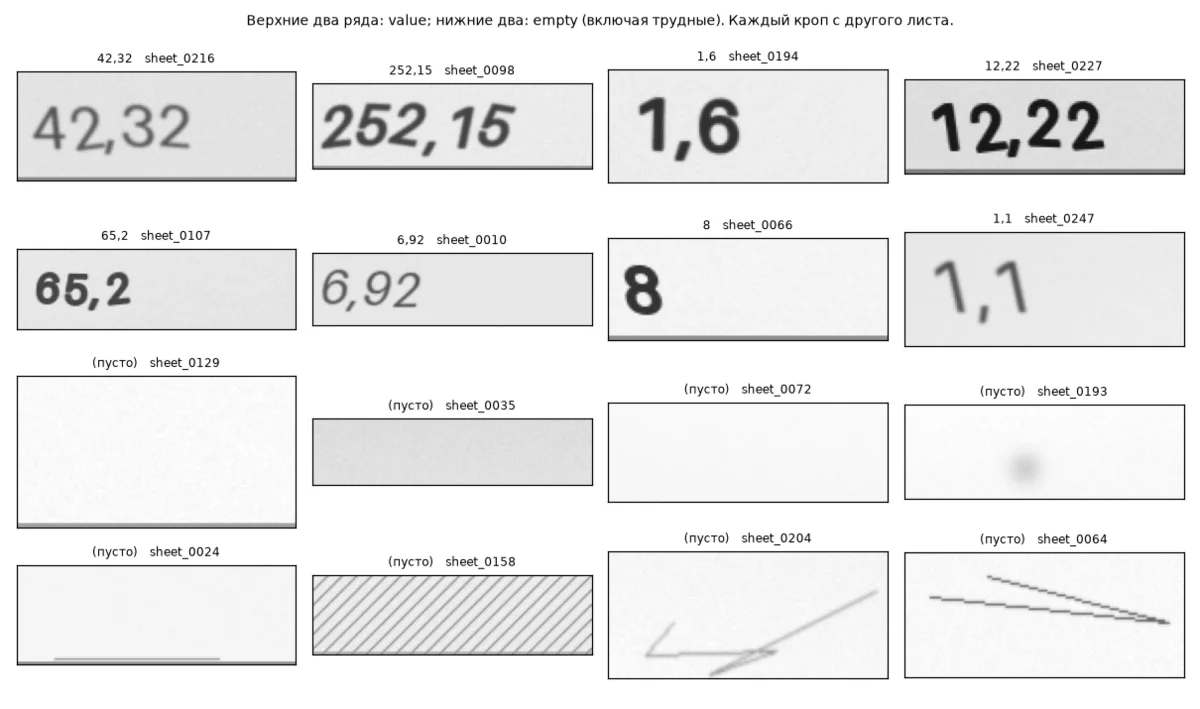
What you see: sheets differ in pen thickness, ink color, slant, blur, and border. Rows of empty cells include clean paper, stain, underline, cross-hatching, and scratches.
Compare with your predictions:
- 5000 crops, 40.6 % empty. Target was 40 %, result slightly higher: each crop is empty independently with probability 0.4.
- Repeats: 47 %, not 30 %. Field
repeated_on_sheet_shareis the fraction of value crops whose value appears on the sheet at least twice. A repeat counts both copies: original and duplicate. Plus random collisions on short numbers (e.g.7). So 47 % with--repeat-share 0.3is not a bug. - The contract will fire. Swapping one label to
7.3inindex.jsonlmakesprepare_dataset.pyprint:
Источник не соответствует контракту:
  - sheet_0000_000: метка не нормализована: '7.3'
  - sheet_0000_000: символ '.' вне алфавита: '7.3'
and exit code 1. No files appear in data/processed in that case.
Patterns among value crops: dec1 49.8 %, dec2 26.4 %, int 18.6 %, lead0 5.3 %. Every rare pattern is well above 3 %.
Exercise
- Generate two datasets with
--repeat-share 0and--repeat-share 0.6(into different folders) and comparerepeated_on_sheet_sharein the manifests. Why is the share still non-zero when the parameter is zero? - Add your own hard empty kind, e.g. a "cross" from two diagonals. Add a key to
EMPTY_KINDSand a branch indraw_empty_marks. Testtest_all_hard_negative_kinds_occurwill check that your kind appears. - Raise
paper_noiseinsample_styleto 8 and run tests. Which test fails and what does that say about lesson 2?
If it fails
NotImplementedErrorinalphabet.validate_format(orencode_text). Not a generator bug:src/alphabet.pystill has the lesson 3 starter. Finish the TODOs or take the solution from lesson 3;pytest tests/test_alphabet.pyshould show 12 passed.- "No index.jsonl in … First: python src/make_synthetic_crops.py …". You ran
prepare_dataset.pybefore the generator or passed the wrong folder in--src. - "Source does not match the contract". Not a crash — the checker doing its job. Read the list: it names the record and the reason.
AttributeError: ... getlengthor very tiny crooked text on crops. Old Pillow. You need 10.1 or newer:pip install -U "Pillow>=10.1".ModuleNotFoundError: data_sourcesoralphabet. Run scripts from your repository root (python src/...) and ensuresrc/data_sources/__init__.pyexists.- Generation takes noticeably longer than a minute. On a typical laptop 5000 crops take on the order of ten seconds. For debugging you can generate less (
--sheets 20), but later lessons need the full set: size depends on lesson 5 arithmetic. --source publicor--source realexits with "will be connected later". Expected: those adapters come in appendices A2 and A4.
Checklist
- Lesson files in your repository and committed
- Full run generated:
--sheets 250 --per-sheet 20 --seed 42 -
prepare_dataset.pywroteall.jsonlandmanifest.json - Grid
samples_grid.pngsaved - Lesson 4 pytest → 13 passed
- Compared three forecasts from "Predict"
FAQ
Why group_id if there is no split yet?
Split in lesson 5 divides sheets, not individual crops. group_id already records which crops belong to one sheet — otherwise style leakage stays invisible in the manifest.
Why is repeated_on_sheet_share larger than --repeat-share?
The generator parameter is the probability of making a repeat when drawing a value crop. The manifest counts the fraction of value crops whose value appears on the sheet ≥ 2 times: both original and copies count, plus random collisions on short numbers.
Should I commit data/synthetic?
No. The folder is in .gitignore. Recreate with --seed 42; the manifest is the same for the same seed.
How does native index.jsonl differ from all.jsonl?
index.jsonl is the generator format (sheet, file, kind, empty_kind). all.jsonl is the course-wide schema via the adapter. Field empty_kind is not in the course schema: the detector only needs is_empty.
Can I generate diameter right away?
Yes: --task diameter. Today the course follows measurement; other tasks matter in lesson 16.
Why is the adapter thin — mostly field renaming?
A fat adapter starts "fixing" data silently. We want checks explicit in check_records, and the adapter only maps names to the schema.
What's next
All 250 sheets still sit in one all.jsonl. Next lesson — Lesson 5. Split by sheets and leakage. Dataset and augmentations — lesson 6.
Reference for comparison: lesson-04. You do not need to clone it. Previous: Lesson 3. Alphabet, labels, format.
Comments