Contents
In brief
Medtech often starts as “transcription API wrapper + LLM summary.” On Dev.to, Fownd Care explains why generic scribes fail for clinicians (especially rehab/PT): the need is not dialogue text but a clinical reasoning engine that structures data in real time for SOAP notes and legacy EMR.
What happened
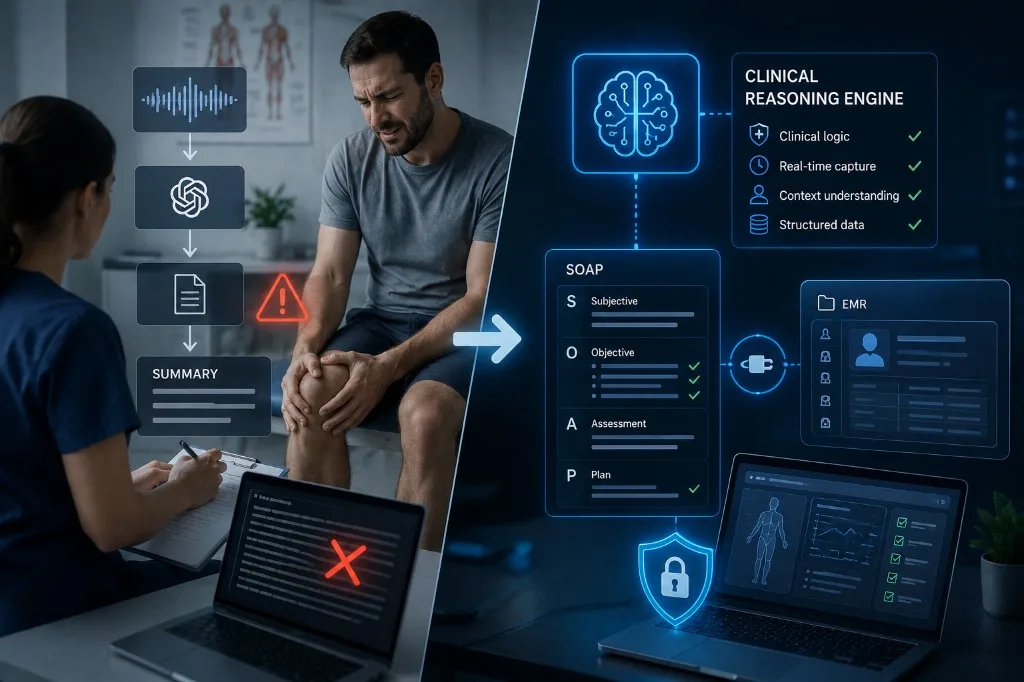
The naive stack: audio → Whisper → prompt → note. Clinicians collect dynamic data during exams — tests, metrics, context — which generic transcription loses.
The author contrasts “audio summary tools” with clinical reasoning engines (e.g. Notation by Fownd): priority is structural clinical logic and compliant SOAP mapping, not raw transcript.
Legacy EMR interoperability is another blocker. The proposed path: a secure browser extension that reduces admin burden without replacing the EMR wholesale.
Why it matters
For engineers entering healthcare, this is domain-first design:
| Approach | Problem |
|---|---|
| Transcribe + summarize | Loses exam structure, no real-time capture |
| Post-hoc LLM edit | Clinician re-checks everything → burnout |
| Clinical reasoning engine | Data captured by clinical logic during the visit |
| Browser extension + EMR | Works around lock-in without big-bang integration |
In regulated domains, a wrong note is compliance and liability, not a UI bug. “Almost correct” summary can be worse than an honest template.
In practice
- Interview clinicians first — specialty workflow defines the data schema.
- Data model around SOAP / specialty forms, not a text paragraph.
- Real-time capture during the visit, not batch after.
- Integration via extension or FHIR where the EMR allows it.
- Security by design: PHI, audit logs, minimize audio retention after structuring.
Takeaway
Healthcare AI is not RAG on a transcript. It needs reasoning engines embedded in clinical workflow and EMR reality — useful for backend/AI developers entering medtech without understanding why “another scribe” fails in production.