

Contents
By mid-2026, most organizations that “adopted AI” have the same financial surprise: model quality is not the binding constraint—uncontrolled inference is. Teams ship assistants, RAG copilots, and agent workflows faster than finance can attribute spend, security can constrain data paths, or platform engineering can stop every service from calling a frontier model with a 32k system prompt.
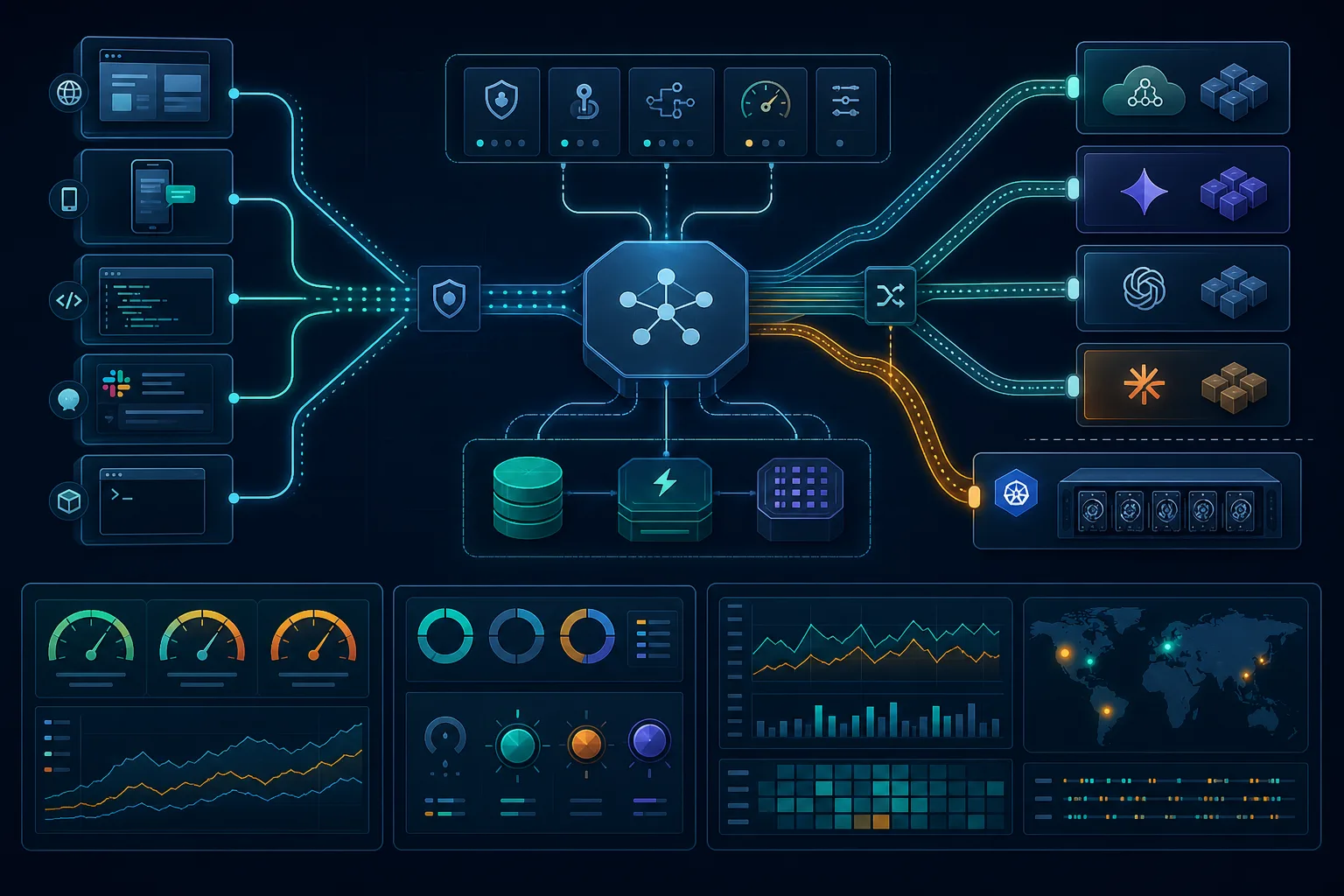
An LLM gateway is the control plane that sits between applications and model providers. Done well, it turns inference into a governed product: authenticated callers, classified requests, routed models, enforced budgets, observable unit economics, and graceful degradation. Done poorly, it becomes another proxy that hides invoices until the bill lands.
This guide is for platform engineers, staff developers, FinOps partners, and engineering leaders who need cost control without a permanent quality cliff. It assumes you already know how to call an API. The hard part is operating a portfolio of models under real traffic, real contracts, and real failure modes. Related decisions—how to select models, AI observability, production RAG, and agentic engineering—belong beside this article, not after it.
Key takeaways
One frontier model for every request is an anti-pattern, not a strategy. It maximizes average cost, concentrates provider risk, and prevents you from learning which workloads actually need frontier capability.
A gateway is a product boundary. Treat it like an internal API platform: identity, quotas, schemas, SLOs, chargeback, and a clear ownership team. If every app owns its own keys and routing, FinOps arrives too late.
Route on request class, not on brand preference. Classification (latency class, risk class, evidence needs, tool use, user-facing vs batch) should drive model choice. Marketing names change quarterly; workload shapes do not.
Token budgets are engineering constraints. Caps on prompt size, retrieval depth, agent steps, and monthly spend protect quality more often than they hurt it—because they force design choices instead of “just add more context.”
Caching, failover, and multi-provider contracts have sharp edges. Semantic cache hits can serve stale answers; cheap fallbacks can silently lower quality; dual-vendor contracts without traffic discipline become unused insurance.
FinOps for LLMs is unit economics plus quality signals. Cost per successful task, cost per accepted answer, and cost of escalation matter more than raw tokens. Blind cost cutting recreates the enterprise AI antipatterns you already know: demos that do not survive production accounting.
Why one model for everything fails in production
The “default everything to GPT-/Claude-/Gemini-latest” pattern feels rational on day one. There is one SDK path, one evaluation baseline, one mental model for prompting. Within a quarter, the same pattern produces four failures that show up on different calendars.
Cost failure. Interactive chat, nightly summarization, embedding refresh, classification, and agent tool loops have radically different willingness-to-pay. Paying frontier rates for “extract JSON fields from a ticket” is not caution—it is negligence dressed as quality culture.
Latency failure. Frontier models are often slower under load. When every UI spinner waits on the same scarce capacity tier, product SLOs and FinOps collide. Users experience “AI is slow”; finance experiences “we bought the expensive tier and still queue.”
Reliability failure. A single provider outage or regional rate-limit event becomes a company-wide incident. Teams discover they have no degraded mode because every prompt assumes the same model’s quirks, tool schema, and context window.
Learning failure. Without a cheaper baseline in the path, you never measure the quality delta that justifies spend. You cannot defend budget if you cannot show that a mid-tier model fails a defined eval set by a known margin. Evaluating enterprise AI is not a research hobby; it is how you keep the expensive path honest.
A healthier default is a small portfolio: a fast cheap model for classification and extraction, a strong mid-tier for most user-facing generation, a frontier tier for hard reasoning and high-stakes synthesis, plus specialized models for embeddings, reranking, and code when those dominate the workload. The gateway’s job is to make that portfolio usable without turning every product team into a model-procurement committee.
Reference architecture for an LLM gateway in 2026
Think of the gateway as five layers that must remain separable even if they ship as one service:
- Edge and identity — mTLS or mesh identity for services; OAuth/OIDC or signed service tokens for apps; human identity only where a user-facing product truly needs per-user attribution.
- Policy and routing — request taxonomy, allowlists, model maps, budget checks, and residency constraints evaluated before provider calls.
- Execution adapters — OpenAI-compatible or provider-native clients, tool/MCP passthrough where needed, streaming, retries with jitter, and circuit breakers.
- Side effects — prompt/response logging policies, redaction, semantic and exact caches, async evaluation hooks, abuse detection.
- FinOps and observability export — metrics, traces, cost records, chargeback labels, and alerts that finance and SRE can both trust.
A practical topology for mid-size companies:
Clients (web, backend jobs, agents, IDE bots)
        |
        v
API Gateway / Service Mesh  -->  AuthN/Z, WAF, rate limits
        |
        v
LLM Gateway (control plane)
  - classify request
  - enforce budget + schema
  - choose model route
  - apply cache policy
  - call provider adapter(s)
  - emit cost + quality telemetry
        |
        +--> Provider A (primary region)
        +--> Provider B (failover / alternate model)
        +--> Self-hosted / VPC endpoint (sensitive classes)
        |
        v
Data plane companions (optional but common)
  - retrieval service / RAG
  - tool / MCP gateway
  - eval workers
  - feature store for routing features
Two design rules prevent years of regret. First, applications must not hold raw provider keys for production traffic. Second, the gateway must emit a stable internal model alias (chat.fast, chat.balanced, chat.frontier, extract.strict) so product code does not hardcode vendor model IDs that churn. Providers remain an implementation detail behind the alias—exactly how you already treat databases behind a connection string.
If you also expose tools through MCP in production, keep tool authorization in a sibling control plane. Folding unconstrained tool execution into the same process that merely routes tokens creates a blast radius you will not enjoy during the first prompt-injection incident.
Request taxonomy: classify before you route
Routing without taxonomy is superstition. Before a model is chosen, every request should carry—or be assigned—a small set of labels that policy can read.
Interactive vs batch. Interactive traffic needs p95 latency budgets and user-visible degradation. Batch can prefer cheaper capacity, longer contexts, and deferred retries.
Generation shape. Classification, extraction, short rewrite, long synthesis, multi-step agent, multimodal, and embedding are different products. Collapsing them into “chat completions” hides the levers you need.
Risk class. Public marketing copy, internal knowledge Q&A, customer PII, regulated advice, and code that can mutate production systems do not share the same logging, residency, or human-approval rules.
Evidence needs. Some answers must cite retrieved sources; some must not leave the approved corpus; some are creative and should avoid retrieval entirely. RAG depth is a cost and quality dial—see production RAG engineering.
Caller and product. Chargeback dies without team, product, environment, and feature labels at the gateway. Inferring them later from URLs is folklore.
A minimal taxonomy table that has survived real platforms:
| Dimension | Example values | Why it matters |
|---|---|---|
| Latency class | sync-ui, sync-api, async-job | Model and region choice |
| Task type | classify, extract, generate, agent, embed | Portfolio mapping |
| Risk tier | public, internal, confidential, restricted | Logging, residency, human gate |
| Quality tier | draft, standard, certified | Eval gates and model floor |
| Spend class | free-tier, metered, priority | Budget and queueing |
Classification can be rule-based for most traffic (headers and route names) with an optional cheap model only when the client cannot declare intent. Do not spend a frontier call to decide whether the next call should be frontier.
Routing policies that preserve quality
A routing policy is a function from taxonomy + runtime signals to a model alias, with explicit fallbacks. Good policies are boring, versioned, and tested.
Static maps for the bulk of traffic. extract.strict → mid-tier-json-model, chat.ui.default → balanced, incident.summary → frontier. Static maps are debuggable. Teams can reason about them in code review.
Feature-aware overrides. Use online features sparingly: prompt token estimate, retrieval hit quality, user plan, previous failure codes, regional capacity. Every feature you add is a regression surface.
Quality floors, not only cost ceilings. For quality=certified or risk=restricted, policy should refuse to route below a model tier even if the budget is nearly exhausted. The correct behavior is to queue, degrade the feature, or require human review—not to silently answer regulated questions with a toy model.
Shadow routing for migrations. When you introduce a cheaper candidate, clone a percentage of traffic to the candidate, score offline or async, and promote only when the eval delta is acceptable. Shadow traffic still costs money; bound it.
Kill switches. Every alias needs an emergency pin: force a known-good model, disable a provider, or shed non-critical classes. FinOps incidents and provider incidents both need the same lever.
Benchmark folklore is a poor router. A public comparison such as DeepSeek V4 Flash versus GPT-4o can inform hypotheses, but production routing must follow your task distribution, language mix, tool schemas, and failure costs. Import numbers; do not outsource judgment.
Token budgets as first-class engineering constraints
Token budgets are the LLM equivalent of memory limits and CPU quotas. Without them, every prompt engineer “temporarily” expands context until the gateway becomes a shared tragedy.
Prompt budgets. Cap system prompt size per product, require shared prompt modules instead of copy-paste essays, and reject requests that exceed class limits before they hit a provider. A 40k-token system prompt that restates the same policy twelve times is not safety—it is waste.
Retrieval budgets. Bound chunks, characters, and rerank depth by request class. RAG quality often improves when you retrieve less but better; unbounded top-k is a cost bug with a search costume.
Agent step budgets. Multi-agent and tool loops can spend more on intermediate tokens than on the final answer. Cap steps, parallel tool fan-out, and retries. Agentic engineering without step accounting is how invoices grow while demos still look calm.
Conversation budgets. Cap retained turns, summarize older history with a cheap model, and store durable state outside the prompt. Infinite chat history is not a product requirement; it is an accident.
Economic budgets. Per-key, per-team, and per-feature monthly caps with soft alerts and hard stops. Soft-only budgets train nobody. Hard stops must include a break-glass path for incident response so on-call does not disable the gateway entirely.
Implement budgets as policy checks with clear error codes (budget.prompt_tokens, budget.monthly_team, budget.agent_steps) so clients can adapt. Silent truncation is worse than a loud refusal: truncation destroys answer fidelity while still billing you for the attempt.
Caching: real savings, real ways to ship wrong answers
Caching is the first FinOps lever teams reach for and the first quality footgun they step on.
Exact-match cache. Identical model alias + temperature 0 + identical messages can return a stored completion. Ideal for repeated extractions, FAQ-like prompts, and deterministic transforms. Fragile when prompts embed timestamps, request IDs, or lightly reordered JSON.
Prompt-prefix / provider prompt caching. Some providers discount repeated prefixes. This rewards stable system prompts and hurts designs that randomize large prefixes. Measure provider-specific behavior; do not assume portability.
Semantic cache. Embed the user question, return a previous answer for “similar” queries. This can slash spend for support-like traffic and also serve the wrong customer the right-looking answer. Require tight similarity thresholds, tenant isolation, source-document version pins for RAG answers, and explicit bypass for high-risk classes.
Tool-result cache. Cache expensive tool or retrieval results separately from model completions. Often higher ROI than caching the final prose, because many prompts differ only in wording while sharing evidence.
Negative caching. Remember recent provider failures carefully. Cache “model X overloaded” for seconds, not “this user question has no answer” for days.
Operational rules that keep caches honest: include policy version, prompt template version, and index version in the cache key for RAG; never share semantic cache entries across tenants; expose cache_hit in traces; and give operators a flush by product. A cache that cannot be invalidated is a liability with a hit-rate dashboard.
Failover and degradation without silent quality loss
Failover is not “try the next model string in a list.” That pattern converts provider outages into subtle product bugs: different tool-calling behavior, weaker instruction following, truncated outputs, or hallucinated confidence.
Design degradation as declared modes:
- Mode A — same alias, alternate provider for the same capability tier (contractual twin).
- Mode B — lower tier with UX disclosure (“quick answer” vs “deep answer”) when capacity or budget is constrained.
- Mode C — retrieval-only or template answers for FAQ classes when generation is unavailable.
- Mode D — human queue for restricted risk tiers.
Each mode needs acceptance tests. If Mode B cannot satisfy the eval floor for that product, it must not be attached as an automatic fallback. Prefer failing a non-critical feature over answering a compliance question incorrectly with a smile.
Timeouts and retries deserve the same discipline. Retrying a 60-second frontier call three times can turn one user mistake into a four-call bill and a thread pileup. Use idempotency keys for side-effecting tools, retry only transient provider errors, and budget total wall-clock time per user action.
Circuit breakers belong per provider and per model alias. When error rates spike, shed batch traffic first, then low-priority interactive classes, and protect certified paths last—or park them in human review if no safe model remains.
Multi-provider contracts: insurance you must actually exercise
Procurement loves dual-vendor slides. Production only benefits if traffic engineering matches the paperwork.
What to negotiate beyond unit price. Rate-limit headroom, regional endpoints, data retention and ZDR options, abuse and indemnification language, support SLOs during incidents, committed-use discounts that do not force you onto the wrong model, and clarity on embedding vs chat vs batch SKUs.
What to require technically. Equivalent auth patterns through your gateway, compatible streaming, enough parity on JSON/tool calling for your aliases, and a test tenant for failover drills.
How to keep the second provider real. Schedule monthly failover exercises. Route a meaningful share of non-sensitive traffic to the secondary under normal conditions—not only during disasters—so schemas and prompt packs stay compatible. Unused secondary contracts expire as fiction.
Self-hosted and VPC endpoints. For restricted classes, private endpoints or self-hosted models can be the primary path, with public SaaS forbidden by policy. That is a routing decision, not an ideological one. Cost models must include GPU utilization, idle capacity, and engineering time—not only token stickers.
Be careful with marketplace aggregators versus direct contracts. Aggregators accelerate experimentation; direct contracts often win on compliance, discounts, and incident support once spend concentrates. Many mature platforms use both: aggregator or broad catalog for exploration, contracted providers for production aliases.
Unit economics, chargeback, and the politics of “AI spend”
Executives ask “what did AI cost?” Engineers should answer with unit economics tied to outcomes.
Useful metrics:
- cost per successful task (ticket resolved, PR summarized with acceptance, document classified correctly);
- cost per user-visible answer that passes automated checks;
- cost per agent run to completion vs cost per abandoned run;
- share of spend by model alias and by product feature;
- cache hit rate and savings vs quality incidents attributed to cache;
- escalation rate to frontier and to humans.
Chargeback is how you stop shadow AI. Bill teams on gateway-metered usage with labels they recognize. Without chargeback, every team externalizes spend to a shared “AI platform” cost center and then demands frontier defaults.
Showback first if politics are sharp: publish weekly reports before enforced budgets. Then move to hard caps with negotiated exceptions. Pair FinOps with product analytics—otherwise teams optimize for cheaper tokens while customer outcomes rot, and leadership correctly concludes that FinOps “broke AI.”
A simple decision rule helps: optimize cost only on paths with a measured quality floor. If you lack evals, you are not doing FinOps; you are gambling. That is why evaluation practice and gateway work share an owner or a formal contract between owners.
Gateway security: the control plane is a target
The gateway concentrates keys, prompts, tools, and sometimes retrieval. Treat it as tier-0 infrastructure.
Key management. Provider credentials live in a secret store; the gateway mints short-lived virtual keys per team with scopes (aliases allowed, budget, risk tier). Rotate on a schedule and on personnel changes. Never log secrets or full Authorization headers.
Prompt and response handling. Define retention by risk class. Redact secrets and common PII patterns before durable logs. Separate debug traces (restricted access) from FinOps aggregates (broader access). “We log everything forever for quality” is how you create a second customer database without consent review.
Abuse and exfiltration. Rate-limit by identity, detect anomalous fan-out (one key, thousands of long prompts), and constrain outbound tool destinations. Prompt injection against tool-enabled agents is an application security problem that lands on the gateway if you terminate MCP or tools there.
Supply chain and config safety. Routing config is production code: review, version, progressive delivery. A bad PR that maps restricted to a public model is a data incident, not a tweak.
Multi-tenant isolation. Semantic caches, logs, and budgets must be partitioned. A cache key that omits tenant ID is a privacy bug with latency benefits.
Security reviews should ask the same questions you ask of an API platform: who can change policy, who can read prompts, what is the blast radius of a compromised service account, and how fast can you revoke. For broader pattern language, pair this with enterprise AI antipatterns and your existing zero-trust standards.
FinOps observability: what to measure beyond token counters
Token counters are necessary and insufficient. You need a telemetry model that explains why spend moved.
Metrics. Requests, tokens in/out, estimated cost, cache hits, route decisions, fallback counts, budget rejections, provider errors, and latency histograms—all sliced by alias, team, product, and risk class.
Traces. One trace per user action that includes classification, retrieval spans, model calls, tool calls, and cache decisions. Without traces, agent spend is mythology. Align with the practices in AI observability.
Logs. Structured events for policy denials and routing choices. Avoid full-fidelity prompt logs in the default path.
Quality hooks. Sample outputs to eval pipelines; track defect budgets alongside dollar budgets. A week of cheap answers that fail factuality checks is not a FinOps win.
Alerting. Alert on spend velocity (burn rate vs monthly budget), fallback ratio spikes, cache-hit collapses, provider error budgets, and sudden shifts to frontier aliases. Alerting only on “total $” weekly is how you learn about problems from finance.
Estimate cost in the gateway even when providers bill asynchronously. Use your own price tables versioned in config. When provider invoices disagree, you want a local ledger to debug mapping errors—not a shrug.
RAG and agent workloads: where cost decisions actually land
Most LLM spend in serious enterprises is not single-turn chat. It is retrieval expansion and agent loops.
For RAG, the expensive mistakes are predictable: embedding everything at huge dimensionality with daily full re-embeds; retrieving 20 chunks “just in case”; stuffing duplicate passages; reranking with a large model when a cross-encoder would do; regenerating answers when the evidence did not change. Fix the retrieval product first—chunking, hybrid search, permissions, evals—as covered in production RAG engineering. Generation model upgrades cannot compensate for a messy index.
For agents, cost is dominated by steps × context growth. Each tool result appended to the working memory taxes every subsequent call. Prefer external memory, compact observations, and early stopping rules. Separate planning models from execution models when the planner needs breadth and the executor needs reliability. Do not run five peer agents “for diversity” on the same ambiguous prompt and call it orchestration—duplicate context is duplicate spend.
When agents call MCP tools, account for tool-side cost and latency in the same FinOps view. A cheap model that triggers an expensive search cluster is not cheap. Gateway labels should propagate to tool gateways so chargeback remains coherent.
Incident patterns: when FinOps and reliability meet
These incidents recur. Name them so you can write runbooks.
The runaway agent. A loop retries a failing tool, accumulates context, and burns the monthly budget overnight. Mitigations: step caps, cost caps per run, circuit breakers on tool error rates, and kill switches per virtual key.
The cache poisoning / stale policy answer. Semantic cache serves pre-update guidance after a policy change. Mitigations: versioned keys, TTL by risk class, flush hooks in content publish pipelines.
The silent downgrade. Failover list includes a weak model; accuracy drops; tickets rise; nobody sees a red dashboard because latency improved. Mitigations: quality monitors, fallback ratio alerts, require disclosure or feature flags for tier drops.
The shared-key storm. One leaked or overly broad key lets a compromised workload call frontier models at scale. Mitigations: scoped virtual keys, anomaly detection, rapid revocation.
The invoice surprise. Provider bill includes a SKU mapping error or an evaluation environment pointed at production aliases. Mitigations: separate env budgets, price-table reconciliation, mandatory labels, deny-by-default for unknown callers.
After each incident, update taxonomy and policy packs—not only “who forgot to set a limit.” Incidents are how FinOps systems learn.
A 90-day plan to install gateway FinOps without freezing delivery
Days 1–15 — Instrument and own. Appoint a gateway owner. Inventory all provider keys and unofficial SDK calls. Put a reverse-proxy or mesh filter in front of the highest-spend services even if routing is still pass-through. Emit labels and estimated cost. Publish a spend map by team. No heroic multi-provider work yet.
Days 16–45 — Taxonomy and budgets. Define request classes and internal aliases. Move two or three production features onto aliases. Enforce prompt and monthly budgets for non-prod first, then prod with soft alerts. Stand up an eval set for those features so cheaper routes can be tested. Turn off raw provider keys for migrated services.
Days 46–70 — Routing and cache. Introduce a balanced default and a cheap path for extraction/classification. Add exact-match cache where determinism exists. Pilot semantic cache only on low-risk FAQ traffic with tenant isolation. Wire fallback modes with explicit quality floors. Begin showback reports that product managers recognize.
Days 71–90 — Contracts, drills, and chargeback. Negotiate or revise provider terms with failover realities. Run a failover game day. Enforce hard budgets for the noisiest teams with break-glass. Document the operating model: who changes routes, who approves frontier defaults, how incidents page FinOps-aware on-call. Schedule the next quarter’s model portfolio review using measured deltas—not vendor keynotes.
Ship thinner slices if needed, but keep the order: visibility → classification → budgets → routing → political chargeback. Reversing that order produces governance theater and shadow pipelines.
Choosing managed vs self-hosted gateway tooling
By 2026 the market roughly splits between managed aggregators and self-hosted proxies. They both speak OpenAI-compatible APIs; they do not share the same control story.
On 19 June 2026, OpenRouter published a comparison of OpenRouter and LiteLLM that is useful if you read it as vendor-authored guidance with explicit caveats—not as universal law. Per that post: OpenRouter is a managed gateway (described as running on Cloudflare’s edge) that applies routing/failover and forwards to upstream providers; LiteLLM is a proxy you operate yourself (Docker/Kubernetes, typically with PostgreSQL and Redis). OpenRouter describes provider pricing passed through at 0% markup plus a 5.5% platform fee on pay-as-you-go credit purchases (BYOK described at 5%, with additional waiver terms for early request volume). LiteLLM is described as free to self-host, with infrastructure cost instead, and an Enterprise tier sold separately for SSO/SCIM/RBAC-style controls. The same post cites LiteLLM self-reported overhead figures on a mock endpoint (about 2 ms median on a tuned multi-instance setup; higher when smaller), and notes OpenRouter adds a network hop you do not tune yourself. Treat every fee percentage and latency number as time-stamped vendor claims—re-verify against current pricing pages, your regions, and your own load tests before procurement. Numbers move; contracts and measurements decide.
Practically: pick managed aggregation when speed of model catalog access matters more than data-plane ownership, and pick self-hosted when keys, prompts, RBAC, and spend ledgers must live inside your boundary. Many teams run both—self-hosted policy in front, aggregator as one upstream—for exploration versus production aliases. Either way, the FinOps disciplines in this article remain yours. A gateway vendor does not replace taxonomy, evals, or chargeback.
FAQ
Do we need a gateway if we only use one provider?
Yes, once more than one team ships LLM features. A single provider does not remove the need for shared auth, budgets, aliases, logging policy, and chargeback. The gateway can have one upstream and still pay for itself through governance. Multi-provider routing is optional; control is not.
Will routing to cheaper models destroy answer quality?
Not if you route by task class and keep quality floors with evals. Blind downgrades destroy quality; measured portfolios often improve products because latency drops and teams iterate faster. Require evidence before promoting a cheap path to a certified class.
How should we set the first token budgets?
Start from p95 prompt sizes on real traffic, not from aspirational prompt templates. Set soft alerts at 70% of a generous cap, then tighten monthly as prompt modules consolidate. Separate budgets for interactive and batch so overnight jobs cannot starve the UI.
Is semantic caching safe for customer support?
Only with tenant isolation, tight similarity thresholds, short TTLs, and exclusion of account-specific or regulated advice. Prefer caching retrieval evidence and boilerplate over caching personalized commitments. Always log cache hits into the same trace as generations.
What is the fastest FinOps win for agent systems?
Cap steps and max context growth per run, then meter cost per completed run versus abandoned runs. Most blow-ups are loops and bloated memory, not the choice between two frontier brands. Add kill switches per virtual key before you optimize model stickers.
How do we prove a frontier model is worth it?
Hold a fixed eval set and business sample; measure quality delta, human edit rate, and downstream task success against the mid-tier default. Promote frontier only for classes where the delta clears a threshold you publish. Re-check quarterly—model mix shifts under your feet.
Should product teams pick models directly?
They should pick capabilities (latency, risk, certified quality), not vendor model IDs. The platform maps capabilities to aliases. Exceptions go through a short RFC with eval evidence and a budget owner. Otherwise every squad recreates procurement.
How do LLM gateways interact with RAG platforms?
The RAG service should own retrieval quality; the LLM gateway should own model choice, budgets, and provider policy for generation and embeddings. Share request IDs and labels across both so cost and quality traces stitch together. Do not double-charge teams mentally for the same feature under two dashboards that disagree.
What belongs in break-glass during an outage?
A documented path to pin aliases to a known-good provider, raise temporary budgets for incident commanders, and disable non-critical batch classes. Break-glass must be audited and time-boxed. Infinite emergency mode becomes the new shadow production.
When is self-hosting models the FinOps answer?
When steady utilization is high, data residency forbids suitable SaaS paths, or unit economics beat vendor tokens after you include hardware, idle capacity, and people. Self-hosting a spiky chatbot “to save money” often costs more. Revisit with measured load, not ideology.
Closing
LLM FinOps in 2026 is not a spreadsheet hobby and not a single proxy checkbox. It is the discipline of classifying work, routing it through a governed gateway, budgeting tokens like any other scarce resource, and judging spend against quality and outcomes. Build the control plane early enough that product teams experience it as acceleration—clear aliases, reliable SLOs, honest fallbacks—rather than as a surprise invoice and a panicked model downgrade.
If you take only one step this week, take visibility with labels. Everything else in this guide—routing, caches, contracts, chargeback—depends on knowing which product spent which tokens for which class of request. Without that, you cannot protect quality or cost. With it, you can finally treat inference like the production dependency it already is.
Related cluster notes
Need this on your systems?
If you want a production vertical slice—RAG, agents, MCP tools, or an LLM gateway with budgets—see the AI implementation service.